

Key Highlights
- Correct and Invisalign both use removable aligners but differ in their treatment capabilities and precision.
- Invisalign is better suited for complex cases such as overbite, underbite, and protruding teeth.
- ClearCorrect is better suited for mild-to-moderate alignment and cosmetic corrections.
- ClearCorrect is generally more affordable, while Invisalign supports advanced treatment planning.
- Comfort and visibility vary slightly based on material, fit, and edge design.
- Long-term results depend on case selection, treatment planning, and retainer use.
- The right choice depends on your dental condition, not just cost or brand.
Choosing between ClearCorrect and Invisalign becomes challenging once you compare how each system actually works. Both rely on a series of clear, removable aligners, but they differ in material design, treatment planning, and the level of control they offer during tooth movement.
These differences affect outcomes. Invisalign uses advanced digital mapping and attachments to guide complex movements, which makes it suitable for bite correction and multi-directional alignment. ClearCorrect follows a more flexible approach that works well for mild spacing, minor crowding, and cosmetic adjustments. The number of aligners, refinement stages, and total treatment time can vary based on these capabilities.
This guide compares ClearCorrect vs Invisalign across treatment capability, cost structure, comfort, and visibility. You’ll see which system handles specific conditions, such as overbite, underbite, diastema, and protruding teeth, and which option aligns with your case requirements and budget.
What are Invisalign Aligners and How Do They Work?
Invisalign is a clear aligner system designed for cases that require higher precision and more controlled tooth movement. It uses SmartTrack material and attachment-assisted planning to improve movement accuracy, especially in complex alignment and bite correction cases.
Invisalign is commonly recommended for protruding teeth, crowding, overbite, underbite, and other cases that require multi-directional movement and detailed treatment control.
What Dental Problems Invisalign Treats
Invisalign is designed for cases that require precise tooth control, bite coordination, and multi-directional movement. It is commonly recommended when alignment problems involve both cosmetic correction and functional bite adjustment.
Invisalign performs best for:
- Overbite and underbite: Uses attachments and elastics to improve bite positioning
- Crossbite and open bite: Controls movement across multiple teeth simultaneously
- Crowded teeth: Creates space through controlled alignment planning
- Protruding teeth: Applies targeted force for accurate repositioning
- Moderate to complex cases: Handles movements requiring higher precision and bite coordination
Where Invisalign has an advantage:
- Complex bite correction
- Attachment-assisted tooth movement
- Multi-directional alignment control
- Cases requiring detailed movement precision
Cases where simpler aligners may become limited:
- Severe bite coordination
- Complex tooth rotation
- Large multi-tooth movement cases
- Cases needing advanced attachment support
With advanced planning and attachment-assisted movement, Invisalign provides predictable correction for both cosmetic and complex orthodontic concerns. To better understand the treatment process, learn more about how Invisalign works.
What Are ClearCorrect Aligners and How It Works?
ClearCorrect is a clear aligner system designed primarily for mild to moderate alignment correction. It uses a thinner aligner material and simplified treatment planning, making it a practical option for cosmetic adjustments and less complex tooth movement.
ClearCorrect is commonly recommended for minor spacing, mild crowding, slightly crooked teeth, and cases that do not require advanced bite coordination or attachment-assisted precision. Its streamlined treatment approach makes it a more budget-friendly option for patients seeking cosmetic alignment improvements without complex orthodontic correction.
What Dental Problems ClearCorrect Treats
ClearCorrect is designed for mild to moderate alignment concerns that do not require advanced bite coordination or complex multi-directional movement.
ClearCorrect performs best for:
- Mild to moderate crowding: Improves spacing and alignment without complex movement
- Minor spacing issues (diastema): Closes small gaps between teeth
- Slightly crooked teeth: Corrects mild cosmetic misalignment
- Minor bite irregularities: Addresses limited bite concerns without extensive correction
- Rotated teeth: Improves minor tooth rotation in simpler cases
- General cosmetic alignment: Focuses primarily on aesthetic improvements
Cases where ClearCorrect may become limited:
- Severe overbite or underbite correction
- Complex bite coordination
- Large multi-tooth movement cases
- Cases requiring advanced attachment-assisted precision
ClearCorrect is most effective for cosmetic and mild alignment correction, while more complex bite and movement cases may require advanced treatment systems like Invisalign.
What Is the Difference Between Invisalign and ClearCorrect?
When comparing Invisalign and ClearCorrect, the key differences lie in treatment precision, material design, and the level of case complexity they can handle, impacting the overall patient experience. While both systems use clear, removable aligners to move teeth, they are built for different treatment demands.
Invisalign treatment is designed for greater control over tooth movement, using advanced digital planning and attachments to guide complex adjustments. ClearCorrect focuses on simpler alignment corrections, offering a more flexible and cost-effective approach for mild-to-moderate cases.
How Do They Differ in Practical Terms?
Here is a clear side-by-side breakdown of dental care options:
Treatment Capability
- Invisalign: Handles mild to complex cases, including bite correction
- ClearCorrect: Best suited for mild to moderate alignment issues
Technology and Planning
- Invisalign: Uses advanced 3D mapping and attachments for controlled movement
- ClearCorrect: Uses standard digital planning with fewer customization tools
Material and Fit
- Invisalign: Made from SmartTrack material for a flexible, precise, and comfortable fit
- ClearCorrect: Uses thinner plastic, which may feel firmer during wear
Cost Range
- Invisalign: Typically higher due to advanced technology and broader treatment capability
- ClearCorrect’s aligners: Generally more affordable for less complex cases
Best Use Case
- Invisalign: Complex alignment, bite issues, and multi-directional movement
- ClearCorrect: Cosmetic corrections, spacing, and minor alignment
Understanding these differences helps narrow your choice. If your case requires precision and complex movement, Invisalign is usually the better fit. If your needs are simpler and cost is a priority, ClearCorrect can deliver effective results.
When Is Invisalign the Better Choice?
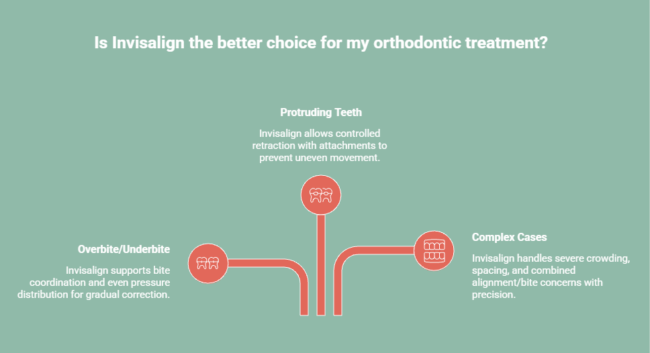
Invisalign is typically recommended when treatment involves complex correction, bite coordination, or tooth movement that requires higher precision and control. It is typically recommended for cases that go beyond simple alignment and involve bite correction or structural changes.
1. Overbite and Underbite
Invisalign is often preferred for overbite and underbite cases because it supports bite coordination, not just tooth alignment.
- Uses elastics to improve upper and lower bite positioning
- Helps distribute pressure across multiple teeth evenly
- Supports gradual correction of functional bite imbalance
2. Protruding Teeth
Invisalign is effective for protruding teeth because it allows controlled tooth retraction without aggressive movement.
- Applies gradual backward pressure to the front teeth
- Uses attachments to improve the aligner grip during retraction
- Reduces the risk of uneven front tooth movement
3. Complex Cases
Invisalign performs better in complex cases that require multi-directional tooth movement and detailed correction planning.
- Handles severe crowding and large spacing cases
- Manages combined alignment and bite concerns together
- Supports more advanced tooth positioning movements
For cases involving bite correction, controlled retraction, or complex alignment movement, Invisalign provides greater treatment flexibility and precision. Patients comparing treatment options can also explore common Invisalign alternatives based on their alignment needs and case complexity.
When Is ClearCorrect the Better Choice?
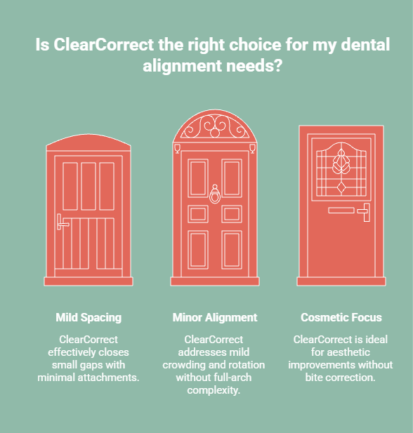
ClearCorrect is often the better choice for mild cosmetic alignment cases that do not require complex bite coordination or advanced tooth movement. Its simplified treatment approach makes it effective for focused corrections with less treatment complexity.
1. Mild Spacing (Diastema)
ClearCorrect works well for small spacing corrections where movement is limited and predictable.
- Closes small gaps through controlled alignment
- Often requires fewer attachments in mild cases
- Suitable for cosmetic spacing improvement without bite correction
2. Minor Alignment
ClearCorrect is effective for mild crowding, slightly rotated teeth, and small alignment irregularities.
- Focuses on targeted correction without full-arch complexity
- Simpler treatment workflow for limited movement cases
- Commonly used for minor post-brace shifting
3. Cosmetic-Focused Cases
ClearCorrect is a practical option when treatment goals are primarily aesthetic rather than structural.
- Lower intervention approach for mild corrections
- Efficient for cosmetic smile improvements
- Tiered treatment options based on correction level
For patients seeking cosmetic alignment improvement without complex bite correction, ClearCorrect offers an efficient, streamlined treatment option.
How Do ClearCorrect vs Invisalign Cost Compare?
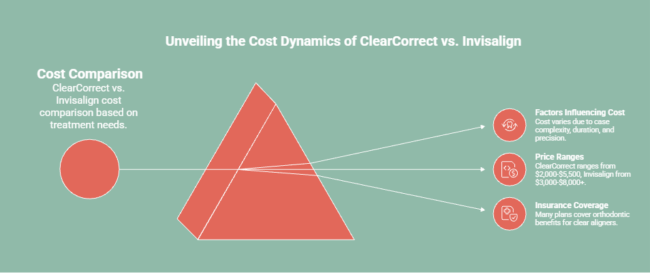
The cost of ClearCorrect and Invisalign depends on treatment complexity, movement requirements, and the level of planning involved. ClearCorrect is generally more affordable for mild cosmetic correction, while Invisalign typically costs more because it supports more advanced movement control and broader treatment capability.
In cases involving bite correction, attachments, or multi-directional movement, Invisalign often requires additional planning and refinement stages, which increases overall treatment cost.
1. What Drives the Cost
The total cost varies because each treatment plan is customized around the complexity of tooth movement and correction goals.
- Case complexity: Advanced cases require more aligners and longer treatment
- Treatment duration: Longer correction plans increase total cost
- Movement precision: Complex repositioning requires more detailed planning
- Attachment planning: Cases using attachments involve greater movement control
- Refinement stages: Additional aligners may be needed to fine-tune results
- Provider expertise: Experience and specialization can influence fees
- Location: Pricing varies by region and clinic
- Insurance coverage: Reduces out-of-pocket expenses depending on the plan
2. How Do Their Price Ranges Compare?
The price difference between ClearCorrect and Invisalign often reflects the level of correction and planning required.
- ClearCorrect: Typically ranges from $2,000 to $5,500 for mild to moderate correction
- Invisalign: Generally ranges from $3,000 to $8,000+ for broader or more complex treatment
Why Invisalign usually costs more:
- Supports advanced bite correction
- Uses attachment-assisted movement planning
- Includes additional refinement stages when needed
- Handles broader treatment scope and complex movement cases
Where ClearCorrect may cost less:
- Mild cosmetic correction cases
- Simpler alignment adjustments
- Fewer attachments and shorter workflows
- Limited treatment tiers for smaller corrections
3. Does Insurance Cover ClearCorrect or Invisalign?
Many dental insurance plans include orthodontic benefits for clear aligners, regardless of the brand.
Coverage may include:
- A percentage of the treatment cost
- A fixed orthodontic allowance
Coverage limits vary by provider and policy. Many dental offices also offer financing plans to help patients manage treatment costs more comfortably. Patients can also explore available dental insurance and payment options before starting treatment.
Which Is More Comfortable to Wear?
Comfort matters because clear aligners are worn for most of the day, including while talking, working, and sleeping. Small differences in fit and material can affect how quickly patients adjust to wearing them and how the aligners feel during daily activities.
Both Invisalign and ClearCorrect are more comfortable than traditional braces, but the wearing experience can feel slightly different depending on tray thickness, tightness, and gum sensitivity.
1. Invisalign Comfort
Many patients choose Invisalign because the aligners are designed to feel smoother and easier to adjust to during long-term wear.
- Often feels smoother against the gums and cheeks
- Less noticeable tightness when switching trays
- Usually easier to adjust to while speaking
- May cause less irritation during extended daily wear
2. ClearCorrect Comfort
ClearCorrect aligners are thinner, which some patients prefer because they feel lighter in the mouth during treatment.
- Thinner trays may feel less bulky
- Can feel tighter during the first few days of a new tray
- Some users notice mild gum irritation initially
- Lightweight feel may improve day-to-day comfort for mild cases
Invisalign is often preferred for a smoother adjustment experience, while ClearCorrect appeals to patients who prefer a thinner and lighter tray feel.
Which Looks More Natural and Less Visible?
Visibility depends on aligner thickness, material clarity, and whether attachments or metal brackets are required during treatment. Both Invisalign and ClearCorrect are designed to be discreet, but certain treatment features can make one system slightly more noticeable than the other.
1. Invisalign Appearance
Invisalign is designed to blend closely with natural teeth, especially in mild cases that require fewer attachments.
- Clear material helps maintain a natural appearance
- Fits closely against teeth for reduced visibility
- Easier to notice when multiple attachments are required
- Attachments may appear as small, tooth-colored bumps during treatment
- Less visible in simpler cases with limited movement needs
2. ClearCorrect Appearance
ClearCorrect uses thinner trays that some patients find less noticeable during daily wear.
- Thinner material may reduce tray visibility
- Clear plastic maintains a discreet appearance when new
- No mandatory attachment use in many mild cosmetic cases
- Straight tray edges may become noticeable at certain angles
Invisalign offers a more blended appearance in many cases, while ClearCorrect may feel less noticeable in mild treatments that require fewer or no attachments.
Which Performs Better for Long-Term Results?
Long-term success depends less on the aligner brand itself and more on retainer use, case selection, and post-treatment follow-up care. Both Invisalign and ClearCorrect can deliver lasting results when patients maintain retention and complete treatment properly.
1. Invisalign Performance
Invisalign is often used for more complex correction cases, which makes long-term monitoring and retention especially important.
- Retainers help prevent relapse after complex bite correction
- Follow-up evaluations are commonly used to monitor stability
- Stable results depend heavily on long-term retainer compliance
- Often recommended when correction involves both bite and alignment changes
2. ClearCorrect Performance
ClearCorrect can provide stable long-term alignment when used for mild to moderate correction cases.
- Works best when treatment goals are primarily cosmetic
- Mild alignment cases generally carry a lower relapse risk
- Consistent retainer use is important for maintaining results
- Long-term stability depends on proper case selection from the beginning
Both systems can provide lasting alignment results, but long-term stability depends more on retainer compliance, follow-up care, and choosing the right treatment for the case complexity.
What Do Most People Get Wrong When Choosing Between Them?
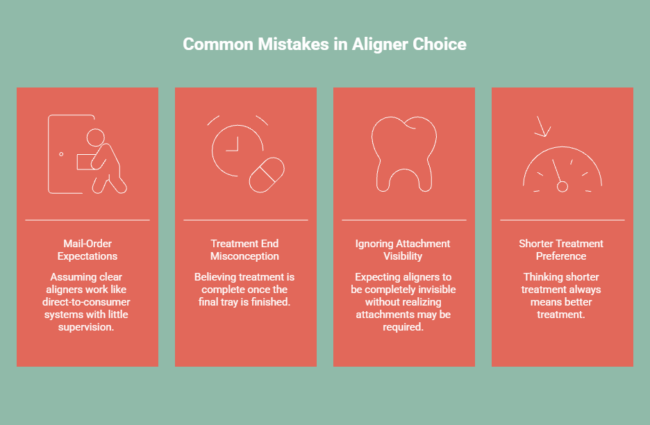
Many patients compare ClearCorrect and Invisalign as if they are interchangeable products, but treatment success depends on far more than price or brand recognition. The biggest mistakes usually happen when people focus only on appearance, treatment length, or online marketing without understanding how aligners actually perform in different cases and considering their specific needs.
The right system depends on movement complexity, bite-correction needs, provider oversight, and long-term retention, not just on whether the trays look similar.
1. Mistaking Mail-Order Expectations for In-Office Treatment
Some patients assume clear aligners work like direct-to-consumer systems that require little supervision. In reality, Invisalign and ClearCorrect treatments depend heavily on professional planning, monitoring, and adjustments throughout treatment.
- Tooth movement must be monitored regularly
- Bite changes may require mid-treatment adjustments
- Complex cases often need provider-guided refinements
- Poor supervision increases the risk of unstable results
2. Assuming Treatment Ends After the Last Aligner
Many people believe treatment is complete once the final tray is finished, but long-term stability depends heavily on retainer use, good oral hygiene, and follow-up care.
- Teeth naturally shift after alignment treatment
- Retainers help prevent relapse over time
- Skipping retention increases the chance of movement returning
- Long-term monitoring helps maintain bite stability
3. Ignoring Attachment Visibility
Patients often expect aligners to be completely invisible without realizing that some Invisalign cases require visible attachments during treatment.
- Attachments may appear as small, tooth-colored bumps
- Complex movement cases usually require more attachments
- Mild cosmetic cases may use fewer or no attachments
- Visibility expectations should match treatment complexity
4. Thinking Shorter Treatment Always Means Better Treatment
Shorter treatment plans may sound appealing, but faster treatment is not always the best option for long-term stability or bite correction.
- Complex movement often requires gradual correction
- Rushed movement may increase instability risk
- Proper sequencing improves long-term results
- Treatment quality matters more than speed alone
The best aligner choice depends on your treatment complexity, retention needs, and long-term smile goals, not just cost or speed. Choosing an experienced provider who prioritizes proper treatment planning and patient-centered dental care can significantly improve treatment success and long-term stability.
Why Choose Dentist Tree of the Heights for Clear Aligners?
Choosing between ClearCorrect and Invisalign is only part of the decision. The outcome depends on how well your treatment is planned and managed from start to finish.
At Dentist Tree of the Heights, the focus is not on recommending a specific brand but on selecting the right approach for your case. Every treatment begins with a detailed evaluation of your alignment, bite, and long-term stability to ensure the aligner system matches your needs.
What Makes Their Approach Different?
- Comprehensive evaluation that considers alignment, bite, and overall oral health to achieve comparable results.
- Case-based recommendations based on complexity, not brand preference
- Digital treatment planning for accurate and controlled tooth movement
- Continuous monitoring to track progress and make timely adjustments
- Comfort-focused care designed for a smooth treatment experience
The goal is to achieve results that are not only straight but stable and functional over time. Book your clear aligner consultation at Dentist Tree of the Heights today to find out whether Invisalign or ClearCorrect is the right fit for your smile.
Conclusion
Choosing between ClearCorrect and Invisalign comes down to how complex your case is and what level of control your treatment requires. Invisalign is better suited for cases that involve bite correction, severe bite problems, protruding teeth, or multi-directional movement, while ClearCorrect works well for mild spacing, minor alignment issues, and cosmetic adjustments. Both systems are effective when used for the right purpose and can contribute to long-term oral health, reducing the risk of issues such as gum disease when planned correctly.
The most important step is not choosing a brand, but choosing the right treatment for your specific condition that leads to a straighter smile and straighter teeth. A proper evaluation ensures your aligner system matches your needs, your timeline, and your long-term stability. If you’re unsure which option fits your case, a consultation can help you make a clear and confident decision.
Frequently Asked Questions
Which aligner is more comfortable for long-term wear?
Invisalign, developed by Align Technology, is generally more comfortable for long-term wear due to its flexible material and contoured edges, providing a more comfortable experience compared to ClearCorrect, which may feel thinner but can cause slight initial irritation depending on fit and edge design.
How do treatment durations compare between ClearCorrect and Invisalign?
Treatment duration is similar for both systems, typically ranging from 6 to 18 months. Invisalign may take longer for complex cases, while ClearCorrect is often shorter for mild alignment needs.
What factors should I consider when choosing between ClearCorrect and Invisalign?
Consider case complexity, treatment goals, cost, comfort, provider expertise, and compliance. Invisalign suits complex corrections, while ClearCorrect fits mild cases. The best way to determine the right choice for your orthodontic care depends on how well the system matches your specific alignment needs.
What is the clearcorrect vs invisalign comparison in simple terms?
The ClearCorrect vs Invisalign comparison comes down to treatment capability and precision, helping patients achieve a more confident smile with ClearCorrect’s aligners. Invisalign handles complex cases with advanced planning, while ClearCorrect’s aligners are better suited for mild to moderate alignment and cosmetic corrections.
Can clearcorrect vs invisalign overbite correction deliver the same results?
ClearCorrect vs Invisalign overbite correction differs in capability. Invisalign is more effective for moderate to severe overbite cases, while ClearCorrect may work for mild bite issues that do not require advanced tooth or jaw movement, including adjustments to the upper teeth and lower teeth.
Is clearcorrect vs invisalign diastema treatment effective for closing gaps?
ClearCorrect vs Invisalign diastema treatment is effective for closing gaps. Both systems can correct spacing issues, but ClearCorrect is often preferred for simple gap closure, while Invisalign offers more control for complex spacing cases.
What are the clearcorrect vs invisalign pros and cons patients should know?
ClearCorrect vs Invisalign pros and cons include cost, treatment capability, and precision tailored to individual needs. Invisalign offers advanced control for complex cases, while ClearCorrect helps you make an informed decision by being more affordable and effective for mild alignment, but may have limited functionality for severe corrections.
How does clearcorrect vs invisalign for underbite correction compare?
ClearCorrect vs Invisalign for underbite correction varies by severity. Invisalign, with its set of aligners, is better for moderate to complex underbite cases due to attachments and planning tools, while ClearCorrect may only handle minor bite adjustments.
What is the clearcorrect vs invisalign cost comparison in real cases?
ClearCorrect vs Invisalign cost comparison shows ClearCorrect is generally less expensive for mild cases, while Invisalign costs more due to its ability to treat the complexity of the case along with complex alignment and bite issues with advanced planning and attachments, backed by years of experience.
Do ClearCorrect and Invisalign differ in maintenance or cleaning requirements?
Yes. Both require daily rinsing, brushing, and proper storage, but Invisalign attachments may need more detailed cleaning around the teeth. ClearCorrect’s thinner trays may stain faster if not cleaned consistently