

Key Highlights
- Dental implants are highly successful, but results depend heavily on the provider’s experience, planning, and case handling
- Qualified professionals include oral surgeons, periodontists, prosthodontists, and experienced general dentists, depending on case complexity
- Choose a specialist based on real implant experience, use of advanced technology, and ability to handle complex cases
- Good candidates need healthy gums, sufficient bone, and stable overall health, though some conditions can be managed before treatment
- Factors like bone loss, smoking, uncontrolled health issues, or certain medications may delay or affect eligibility
- Focus on providers who offer clear communication, proven results, and complete treatment planning, not just titles
- At Dentist Tree of the Heights, we provide all-in-one implant care with advanced technology, expert collaboration, and a comfortable patient-first experience
Losing a tooth is not just about how your smile looks. It can make eating uncomfortable, affect how you speak, and slowly chip away at your confidence in everyday situations. Naturally, you want a solution that actually lasts.
According to the American Academy of Implant Dentistry, dental implants have a success rate of 95% to 98% when placed by experienced professionals. That sounds reassuring, but here is the catch.
The success of your implant depends a lot on who is doing the procedure.
That is exactly what this blog will help you figure out. We will break down who is truly qualified to place dental implants and how to choose the right provider for your situation without second-guessing your decision.
What Are Dental Implants?
Dental implants are small titanium posts placed into your jawbone to replace missing tooth roots. Once healed, they support a crown, bridge, or denture and restore how your teeth look, feel, and function in daily life.
What makes implants different is a process called osseointegration, where the implant fuses with your jawbone. This creates a stable foundation that does not shift or depend on nearby teeth.
Each implant has three parts: the post placed in the bone, the abutment that connects it, and the crown that looks like a natural tooth.
For patients, this leads to real everyday benefits. You can chew comfortably without worrying about movement, speak clearly without slips, and smile with confidence. Because implants stimulate the jawbone, they also help prevent bone loss that can change your facial structure over time.
Unlike dentures or bridges, implants are designed to feel natural and last for years, making them a reliable long-term solution for restoring comfort, function, and confidence.
Who Is Actually Qualified to Do Dental Implants?
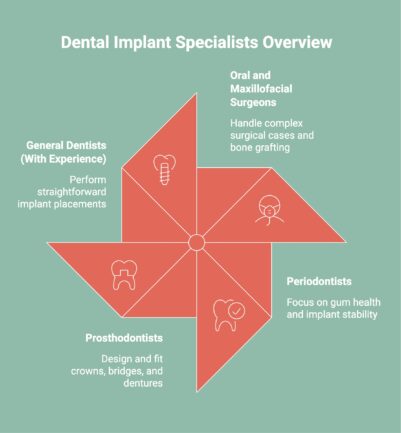
Not every dentist approaches implants the same way. While several professionals can perform the procedure, the difference lies in how much focused training and real clinical experience they have. The right choice depends on how complex your case is.
Here are the main professionals who perform dental implants:
1. Oral and Maxillofacial Surgeons
These specialists focus on surgical procedures involving the jaw and facial structures, making them highly experienced in implant placement.
- Training Background: After dental school, they complete a 4 to 6-year surgical residency, often in a hospital setting, where they are trained in anesthesia, complex surgery, and emergency care.
- What They’re Good At: They handle advanced cases like bone grafting, sinus lifts, and implants placed close to nerves or sinuses.
- When They’re the Right Choice: If your case involves multiple implants, bone loss, or surgical complexity, they are usually the safest option.
2. Periodontists
Periodontists focus on the gums and supporting bone, both of which are critical for implant success.
- Training Background: They complete a 2 to 3-year residency after dental school, focused on gum disease treatment and implant placement.
- What They’re Good At: They specialize in placing implants in healthy tissue and managing issues like gum disease or bone loss.
- When They’re the Right Choice: If you have gum problems or want better long-term implant stability, they are a strong option.
3. Prosthodontists
Prosthodontists specialize in restoring teeth and ensuring the final implant looks and functions properly.
- Training Background: They complete a 3-year advanced program in restorative and prosthetic dentistry after dental school.
- What They’re Good At: They design crowns, bridges, and dentures that fit well, look natural, and align correctly with your bite.
- When They’re the Right Choice: If your case involves full-mouth restoration or cosmetic precision, they play a key role.
4. General Dentists (With Implant Experience)
Some general dentists offer implant services, but their expertise depends heavily on additional training and case volume.
- Training Background: Beyond dental school, they may complete short-term implant courses or certification programs, which can range from a few months to ongoing mentorships.
- What They’re Good At: They typically handle straightforward implant placements using modern diagnostic tools.
- When They’re the Right Choice: If your case is simple and the dentist has strong hands-on experience, this can be a practical option.
Before you decide on implants, make sure you are choosing the right dentist. This guide will help you get it right: how to find a good dentist in Houston
How to Choose the Right Dental Implant Specialist?
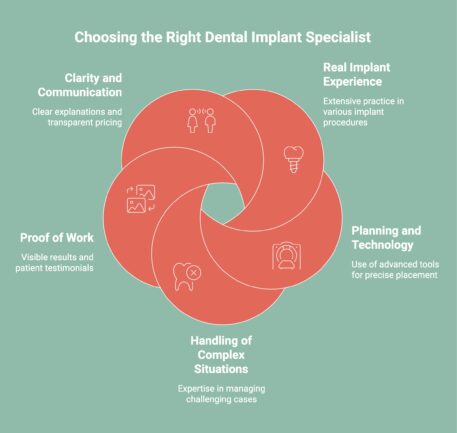
Picking a provider for dental implants is not just about their title. What really impacts your results is how often they perform implants, how they plan cases, and how well they handle complications.
Here is what you should pay close attention to:
1. Real Implant Experience
Do not just ask “how many years.” Ask what kind of implant work they actually do.
A strong provider should:
- Place 50 to 100+ implants per year (not just a few cases)
- Have experience with single-tooth, multiple implants, and full-mouth cases
- Handle bone grafting and immediate implants (same-day placement after extraction)
This tells you they are not just trained, but actively practicing and refining their skills.
2. Planning and Technology
Implants should never be placed blindly. Proper planning tools make a huge difference in safety and accuracy.
Look for clinics that use:
- CBCT scan (3D imaging): shows bone density, nerve position, and exact placement depth
- Intraoral scanner: creates a precise digital model of your teeth and bite
- Guided implant surgery: a digital guide that helps place the implant at the exact angle and position
If a clinic is only using basic X-rays, that is a limitation.
3. Handling of Complex Situations
You want someone who can handle more than just “easy” cases.
They should be comfortable with:
- Bone grafting when there is not enough bone
- Sinus lift procedures for upper jaw implants
- Nerve proximity cases where precision is critical
If more complex cases are often referred out, it may suggest their focus is mainly on simpler procedures.
4. Proof of Work
You should be able to see real results, not just hear claims.
Ask for:
- Before-and-after photos of actual patients
- Cases similar to yours (for example, front tooth, full-mouth, or low bone cases)
- Consistency in results, not just one or two good examples
5. Clarity and Communication
A good provider will break everything down clearly before starting.
They should explain:
- Whether you need bone grafting or additional procedures
- The timeline (healing, placement, crown fitting)
- The total cost, not just the implant part
If things feel vague or rushed, that is a red flag.
When these elements are in place, implant treatment becomes far more predictable. That is what separates a routine procedure from a confident long-term result.
Who Qualifies for Dental Implants?
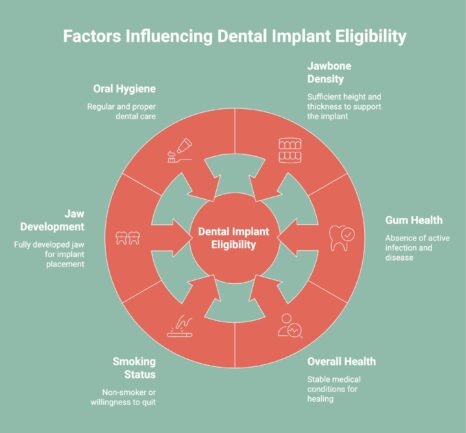
Dental implants are not suitable for everyone right away. Whether you qualify depends on your bone strength, gum health, and overall medical condition. While understanding who qualifies is important, it is equally important to know who is most qualified to do dental implants, as both factors directly impact long-term success.
Key eligibility factors include:
- Adequate jawbone density: Your jawbone needs enough height and thickness to support the implant. If the bone has shrunk due to tooth loss, procedures like bone grafting can often rebuild it.
- Healthy gums: Gums should be free from active infection. Untreated gum disease can interfere with healing and increase the risk of implant failure.
- Good overall health: Conditions like uncontrolled diabetes or immune disorders can slow healing. If managed well, most patients can still proceed safely.
- Non-smoker or willing to quit: Smoking reduces blood flow and delays healing, increasing the chances of complications.
- Fully developed jaw: Implants are recommended for adults since jaw growth must be complete. There is no strict upper age limit if overall health is stable.
- Good oral hygiene habits: Long-term success depends on proper care. Poor hygiene can lead to infections such as Peri-implantitis.
Even if one or more of these factors are not ideal, it does not automatically rule out implants. A thorough evaluation can identify what needs to be improved before moving forward.
What Are Common Challenges with Dental Implants?
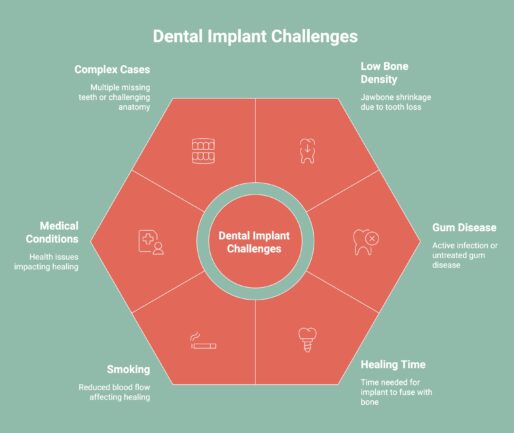
Dental implants are highly reliable, but some challenges can come up depending on your oral health and medical history. With proper planning, most of these can be managed effectively.
Here are some common challenges and how they are addressed:
1. Low Bone Density
When a tooth has been missing for a while, the jawbone in that area can shrink, making it difficult to securely place an implant.
How it is managed: Bone grafting is used to rebuild lost bone and create enough support for a stable implant.
2. Gum Disease or Infection
Healthy gums are essential for implant success. Active infection or untreated gum disease can interfere with healing and increase the risk of failure.
How it is managed: Gum treatment is completed first to restore healthy tissue before moving forward with implant placement.
3. Healing and Integration Time
After placement, the implant needs time to fuse with the jawbone. This process can vary based on bone quality and individual healing response.
How it is managed: A structured healing period is planned, and your provider monitors progress before placing the final crown.
4. Smoking or Reduced Blood Flow
Smoking reduces blood flow to the gums, which can slow healing and affect how well the implant integrates with the bone.
How it is managed: Patients are usually advised to stop or reduce smoking during the treatment period to improve outcomes.
5. Medical Conditions
Certain health conditions, such as uncontrolled diabetes, can impact healing and increase complication risk.
How it is managed: These conditions are stabilized and monitored, often with input from your physician, before proceeding.
6. Complex Cases
Cases involving multiple missing teeth, full mouth restoration, or challenging anatomy require more detailed planning.
How it is managed: A staged or guided approach is used to ensure precise placement and long term function.
Most of these challenges are not barriers but factors that are carefully planned for, helping ensure a safe and predictable treatment outcome.
If you are still weighing your options, dental implants are not the only solution. Here’s how dental veneers can also help with missing teeth.
Why Choose Dentist Tree of the Heights for Dental Implants?
Dealing with a missing tooth is frustrating enough, but what makes it worse is having to visit multiple clinics, coordinate between specialists, and still feel unsure about the outcome.
At Dentist Tree of the Heights, we focus on making your dental implant journey smooth and stress-free from start to finish. We handle consultation, planning, and final restoration all in one place, so you do not have to deal with unnecessary back-and-forth.
Here’s what sets us apart:
- All-in-one care: From diagnosis to final crown placement, everything is handled under one roof
- Team-based expertise: Our dentists collaborate to create a comprehensive treatment plan tailored to you
- Advanced technology: We use digital imaging and modern tools for precise and predictable outcomes
- Comfort-focused approach: Our environment is designed to make your visit relaxed and stress-free
- Wide range of services: From single implants to full-mouth restorations, we handle cases of varying complexity
If you are looking for a clinic that focuses on experience, precision, and patient care, we are here to guide you through the process. Get in touch to take the next step.
Final Thoughts
Dental implants are not just about replacing a tooth. They are about choosing the right expert to get it done right.
The procedure itself is highly successful, but your outcome depends on the experience and approach of the provider. So instead of focusing only on titles, look at real experience, planning, and how confident you feel with them.
At the end of the day, the right choice should feel clear, not confusing. Choose well, and you are not just fixing a tooth; you are investing in your long-term comfort and confidence.
Frequently Asked Questions
Do dental implant qualifications vary by state or country?
Yes, qualifications can vary by state or country due to licensing and regulations for dental specialists and oral surgery. However, core standards focus on patients’ oral health, bone structure, and thorough evaluation for successful dental implant procedures.
How much does a full set of implants usually cost?
The cost of dental implants for a full set varies based on the number of implants, bone quality, and complexity. Typically, full-mouth implants range from $40,000 to $90,000, depending on your specific situation and dental implant process.
Can people with autoimmune disease get dental implants?
Yes, people with autoimmune disease can get dental implants if conditions are controlled. Medical history and overall oral health play a major role. A thorough evaluation ensures suitable candidate status and supports a successful dental implant procedure with proper healing.
Is it better to go to an oral surgeon or a periodontist for dental implants?
Both are highly qualified dental specialists. Oral surgeons handle complex surgical procedures and bone structure issues, while periodontists focus on gums and the supporting structures of teeth. The best choice depends on your individual case and overall oral health.
What is the 3 2 rule for implants?
The 3-2 rule in dental implant placement suggests maintaining 3 mm between implants and 2 mm from a natural tooth. This spacing supports bone quality, preserves natural tooth roots, and ensures a solid foundation for a successful implant procedure.
Who qualifies for immediate implant?
A suitable candidate for immediate implant needs good bone density, healthy gums, and no active infection at the extraction site. Strong bone structure and good oral health help ensure precise implant placement and a successful dental implant procedure.
How can I find the best–qualified implant specialist near me?
Look for dental specialists with advanced training, strong case experience, and modern surgical techniques. Check patient reviews, before-and-after results, and technology used. A consultation today with a dental office helps assess your specific situation and treatment approach.
What questions should I ask my dentist before getting dental implants?
Ask about experience with dental implant procedures, success rates, and advanced training. Discuss your patient’s oral health, bone quality, and medical history. Clarify the dental implant process, costs, risks, healing time, and customized treatment plan.