

Key Highlights
- Laser and Zoom whitening both use professional bleaching agents but differ in how the gel is activated and applied.
- Laser whitening treats one tooth at a time, offering more control for uneven or deeper stains.
- Zoom whitening treats all teeth at once, delivering faster and more uniform results.
- Laser whitening may be preferred for sensitivity or targeted correction, while Zoom suits full-smile whitening.
- Costs vary based on treatment time, technology, and customization, with laser often priced higher.
- Results from both treatments can last with proper care, though maintenance plays a bigger role than the method itself.
- The right choice depends on your stain type, sensitivity level, and how quickly you want results.
Have you ever smiled in a photo and immediately noticed your teeth looked dull or yellow? It’s frustrating, especially when over-the-counter whitening kits promise results but barely make a difference. When your smile doesn’t reflect how confident you feel, it can hold you back in everyday moments.
That’s when treatments like laser teeth whitening and Zoom whitening become relevant. Both can deliver visible results in a single visit, but they differ in how they treat stains, how fast they work, and how your teeth respond during the process.
This guide breaks down the difference between laser and Zoom teeth whitening, including how each treatment works, what results you can expect, and which option fits your needs.
What Is Laser Teeth Whitening and How Does It Work?
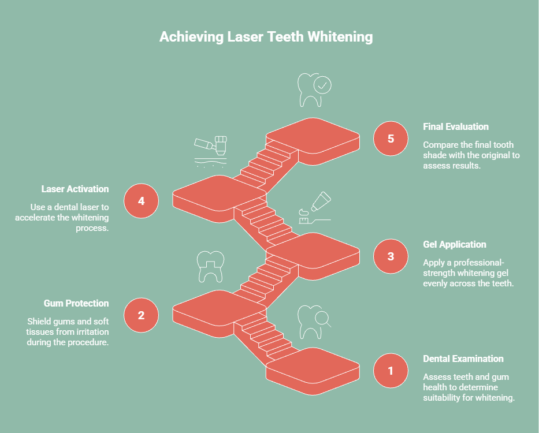
Laser teeth whitening is a professional treatment that uses a high-strength bleaching gel activated by a dental laser to break down stains and lighten tooth colour. The laser accelerates the whitening process, allowing deeper stains to be treated with precision and control.
Unlike general whitening methods, laser whitening focuses on controlled application and targeted stain removal. As part of professional teeth-whitening treatments, some laser systems may provide more precise treatment, which can help reduce sensitivity in certain patients.
1. Dental Examination and Shade Assessment
The process begins with a detailed dental examination to determine whether your teeth and gums are suitable for whitening. The dentist checks for cavities, gum irritation, enamel wear, and existing restorations such as crowns or fillings, since these materials do not respond to whitening agents.
Your current tooth shade is also recorded to measure the improvement achieved after treatment.
- Evaluates enamel and gum health before whitening
- Identifies stain type and whitening suitability
- Establishes a starting shade for comparison
2. Gum and Soft Tissue Protection
Before applying the whitening gel, the dentist protects the gums, lips, and surrounding soft tissues using barriers or protective coverings. This step is important because professional whitening gels contain strong bleaching agents that can irritate soft tissue if exposed directly.
Proper isolation also helps keep the whitening treatment focused only on the teeth.
- Shields gums and soft tissues from irritation
- Keeps the whitening gel contained to the treatment area
- Improves comfort during the procedure
3. Whitening Gel Application
A professional-strength whitening gel is applied evenly across the teeth. The gel usually contains hydrogen peroxide or carbamide peroxide, which penetrates the enamel and begins breaking apart stain molecules within the tooth structure.
The concentration used in professional treatment is significantly stronger than that of over-the-counter whitening products.
- High-strength gel targets internal and surface stains
- Applied evenly for controlled whitening results
- Begins the stain breakdown process before laser activation
4. Laser Activation
Once the gel is in place, the dentist directs the dental laser onto the teeth to activate the whitening agent. The laser accelerates the chemical reaction within the gel, helping it work faster and penetrate discoloration more effectively.
The dentist can also control the laser’s focus and intensity, allowing for more precise treatment of darker or uneven areas.
- Accelerates the whitening reaction
- Helps treat deeper or resistant stains
- Allows targeted correction for uneven discolouration
5. Final Evaluation and Shade Comparison
After the whitening process is completed, the gel is removed, and the teeth are cleaned. The dentist then compares the final tooth shade with the original shade recorded before treatment to assess the degree of whitening and verify overall color consistency.
The dentist also discusses aftercare instructions to help maintain results and reduce temporary sensitivity. Patients are typically advised to avoid staining foods and drinks for the first 24–48 hours and to maintain good oral hygiene.
- Reviews whitening improvement and final tooth shade
- Checks for even color distribution across the smile
- Discusses aftercare and maintenance recommendations
- Provides guidance to help extend whitening results
This structured process enables laser teeth whitening to deliver more controlled, precise results while maintaining patient comfort throughout treatment.
When Laser Whitening Is Typically Recommended
Laser whitening is recommended when standard whitening methods are insufficient or when greater control is needed during treatment. Its targeted approach makes it suitable for specific whitening concerns that require precision rather than full-smile brightening.
- Patients With Deep Stains
Laser whitening is often recommended for stains caused by smoking, coffee, aging, or medication that do not respond well to standard whitening methods. - Patients With Uneven Tooth Color
It helps correct teeth that appear darker due to trauma, aging, or previous dental treatment by allowing targeted whitening on specific areas. - Patients Looking for More Precise Whitening
Since the treatment is performed tooth by tooth, dentists can adjust intensity and focus based on stain severity and sensitivity. - Patients Who Did Not See Results With OTC Whitening Kits
Professional-strength whitening combined with laser activation may improve stains that over-the-counter products could not effectively treat. - Patients Preparing for Events or Cosmetic Treatments
Laser whitening is commonly chosen before weddings, photoshoots, veneers, or other cosmetic dental procedures to improve overall smile appearance.
Laser whitening is best suited for patients who need controlled, targeted treatment instead of general whitening across the entire smile.
What Is Zoom Teeth Whitening and How Does It Work?
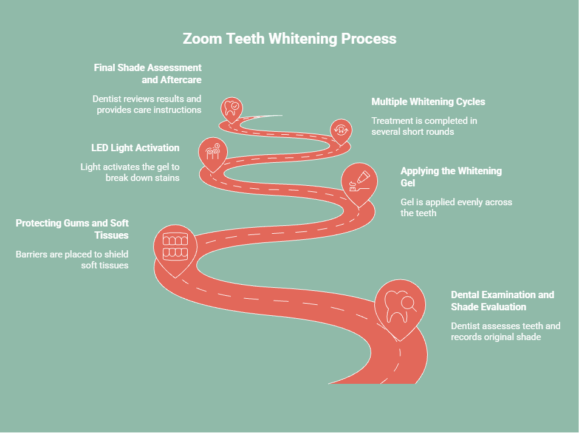
Zoom teeth whitening is an in-office treatment that uses a hydrogen peroxide gel activated by an LED light to quickly lighten tooth color. The light accelerates the whitening reaction across all teeth at once, making it effective for fast, uniform results.
Unlike laser whitening, Zoom treats the full smile in a single session. This approach focuses on speed and even coverage rather than targeted correction.
1. Dental Examination and Shade Evaluation
The treatment begins with a dental examination to determine whether your teeth and gums are suitable for whitening. The dentist checks the enamel condition, existing restorations, and the type of discoloration present.
Your starting tooth shade is also recorded to compare whitening improvement after treatment.
- Assesses stain type and enamel health
- Determines whitening suitability
- Records the original tooth shade
2. Protecting Gums and Soft Tissues
Before whitening begins, protective barriers are placed over the gums, lips, and surrounding soft tissues. This helps prevent irritation from the concentrated whitening gel during treatment.
- Shields soft tissues from the whitening agent
- Keeps treatment focused on the teeth
- Improves patient comfort during the procedure
3. Applying the Whitening Gel
A professional-strength hydrogen peroxide gel is applied evenly across the teeth. The gel is formulated to penetrate enamel and begin breaking down stain molecules.
- High-concentration whitening gel application
- Targets both surface and internal discoloration
- Prepared for LED light activation
4. LED Light Activation
Once the gel is applied, the Zoom LED light is positioned over the teeth to activate the whitening agent. The light accelerates the chemical reaction within the gel, helping stains break down more efficiently.
Because all visible teeth are treated at the same time, the whitening process remains even across the smile.
- LED light activates the whitening gel
- Helps break down stains across all teeth simultaneously
- Supports uniform whitening results
5. Multiple Whitening Cycles
The whitening process is usually completed in several short treatment rounds during one appointment. The dentist monitors shade improvement between cycles to control the whitening progress and reduce excessive sensitivity.
- Multiple short whitening sessions in one visit
- Monitors whitening improvement throughout treatment
- Adjusts treatment duration based on response
6. Final Shade Assessment and Aftercare
After the final whitening cycle, the gel is removed, and the teeth are cleaned. The dentist compares the final tooth shade with the original shade recorded before treatment.
Aftercare instructions are also provided to help maintain results and reduce temporary sensitivity.
- Reviews the final whitening improvement
- Discusses maintenance and sensitivity care
- Provides guidance for preserving results
This structured process allows Zoom whitening to deliver fast, even results across the entire smile within a single appointment.
When Zoom Whitening Is Typically Recommended
Zoom whitening is recommended for patients who want fast, even whitening across their entire smile. Because the treatment works on all visible teeth at once, it is commonly chosen for general discoloration and situations requiring immediate cosmetic improvement.
- Patients With General Yellowing
Zoom whitening works well for overall discoloration from coffee, tea, wine, smoking, or natural aging, improving tooth color across the entire smile. - Patients Wanting Same-Day Results
The treatment is completed in one appointment, making it suitable for patients who want noticeable whitening without multiple visits. - Patients Preparing for Weddings, Events, or Photos
Zoom whitening is often chosen before weddings, photoshoots, interviews, or social events where a brighter smile is desired quickly. - Patients Looking for Full-Smile Brightening
Since all visible teeth are treated simultaneously, the whitening results appear more even and balanced across the smile. - Patients With Mild-to-Moderate Surface Stains
Zoom whitening helps remove stains from food, beverages, and lifestyle habits that affect multiple teeth rather than isolated areas.
Zoom whitening is best suited for patients who want fast, full-smile whitening with consistent results across all visible teeth.
What Is the Difference Between Zoom and Laser Teeth Whitening?
When comparing laser teeth whitening vs Zoom whitening, the difference comes down to how the whitening is applied, how fast it works, and how much control the dentist has during treatment.
Both treatments use a professional whitening gel, but the way that gel is activated and delivered changes the results and experience.
This leads to a simple decision:
Do you need full-smile whitening fast, or precise correction for specific stains?
How Do They Differ in Practical Terms?
Here is a clear side-by-side breakdown:
- Treating One Dark Tooth vs Whitening the Entire Smile
- Laser Whitening: Often chosen when one or two teeth appear darker due to trauma, aging, or previous dental treatment, because the dentist can focus on specific areas individually.
- Zoom Whitening: More suitable when the goal is to brighten all visible teeth evenly during a single session.
- Slower Customized Treatment vs Faster Full-Smile Results
- Laser Whitening: The tooth-by-tooth process takes longer but allows more control over uneven discoloration and stain severity.
- Zoom Whitening: Usually completed within one appointment, making it popular for patients preparing for weddings, photos, interviews, or events.
- Precision Whitening vs Uniform Brightening
- Laser Whitening: Helps when certain teeth require more whitening than others, especially in cases of isolated stains or uneven tooth color.
- Zoom Whitening: Creates a more balanced overall appearance by treating all teeth simultaneously.
- Deep Stains vs Surface-Level Discoloration
- Laser Whitening: Often recommended for stubborn stains caused by smoking, medication, or long-term discoloration.
- Zoom Whitening: Commonly used for general yellowing and surface stains caused by food, beverages, or aging.
- Controlled Treatment vs Convenience
- Laser Whitening: Better suited for patients who need a more customized whitening approach based on sensitivity or uneven staining.
- Zoom Whitening: Preferred by patients looking for a faster treatment with noticeable whitening in one visit.
Your choice comes down to whether you want fast, full-smile whitening or a more precise, targeted treatment, and understanding whether teeth whitening is safe can help you feel more confident about the option you choose.
When Is Laser Teeth Whitening the Better Choice?
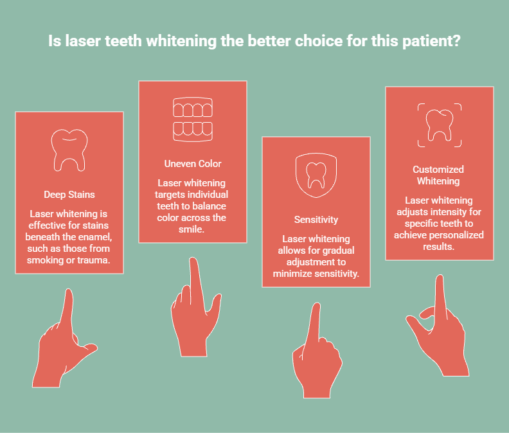
Laser teeth whitening is the better choice when you need precision, controlled application, or treatment for deeper stains. Its targeted approach allows dentists to adjust intensity and focus on specific areas, making it suitable for cases where uniform whitening is not enough.
1. Patients With Deep or Internal Stains
Laser whitening may be more effective for stains that extend beneath the enamel surface. These stains can develop from long-term smoking, medication use, aging, or internal tooth darkening after trauma or root canal treatment.
Some intrinsic discoloration, such as tetracycline staining, may improve only partially, even with professional whitening. In these cases, laser whitening can help improve shade appearance, but results are not always completely uniform.
- Helps treat deeper discoloration more precisely
- Commonly used for trauma-related tooth darkening
- May improve stubborn stains that responded poorly to OTC products
2. Patients With Uneven Tooth Color
Laser whitening is useful when one or two teeth appear darker than the surrounding teeth. This commonly occurs after dental trauma, previous dental procedures, or uneven aging patterns.
Because the treatment is performed tooth by tooth, dentists can focus more attention on darker areas without over-whitening the entire smile.
- Targets isolated discoloration individually
- Helps improve color balance across the smile
- Allows more controlled shade adjustment
3. Patients Concerned About Sensitivity
Some patients prefer laser whitening because the treatment can be adjusted more gradually during the procedure. Dentists can control where the whitening gel is applied and how intensively certain teeth are treated.
This may help reduce unnecessary exposure to sensitive areas or teeth with thinner enamel.
- More controlled application during treatment
- Helps manage whitening around sensitive areas
- Useful when comfort is a treatment priority
4. Patients Who Need More Customized Whitening
Laser whitening is often chosen when whitening goals differ across teeth. Some teeth may require additional correction, while others may already be close to the desired shade.
The individualized approach allows for treatment adjustments throughout the procedure, rather than applying the same whitening intensity everywhere.
- Treatment can be adjusted tooth by tooth
- Useful for uneven staining patterns
- Supports more customized cosmetic results
Laser whitening is best suited for patients who need more controlled treatment, correction for uneven discoloration, or improvement of deeper internal stains that may not respond well to standard whitening methods.
When Is Zoom Teeth Whitening the Better Choice?
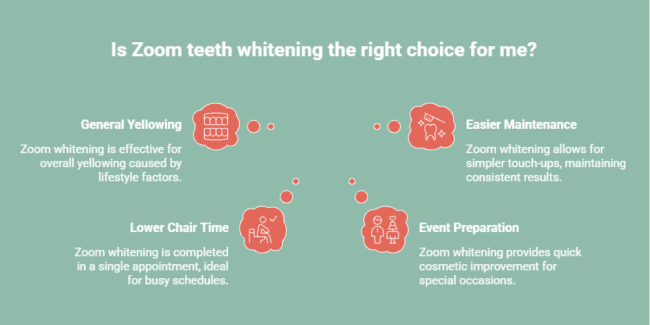
Zoom teeth whitening is the better choice when your goal is fast, full-smile whitening with even results. It treats all teeth at once, making it effective for general discoloration and situations where time matters.
After understanding how Zoom whitening works, the next step is to identify when it becomes the more practical choice compared to laser treatment.
1. Patients With General Yellowing or Surface Stains
Zoom whitening is commonly recommended for overall yellowing caused by coffee, tea, wine, smoking, or natural aging. Since the treatment works across the entire smile at once, it helps create a more balanced and predictable shade improvement.
- Suitable for discoloration affecting multiple teeth
- Helps improve overall smile consistency
- Commonly used for lifestyle-related staining
This makes Zoom more practical when staining is spread evenly rather than isolated to one or two teeth.
2. Patients Wanting Lower Chair Time
Many patients choose Zoom whitening because the treatment is completed in a single appointment, with a shorter overall chair time than more detailed whitening procedures.
This makes it useful for busy schedules, work commitments, or patients who prefer fewer dental visits.
- Shorter overall treatment appointment
- Convenient for time-sensitive schedules
- Reduces the need for multiple whitening sessions
Zoom whitening is often preferred when convenience is a major factor in treatment decisions.
3. Patients Preparing for Events or Professional Appearances
Zoom whitening is commonly chosen before weddings, photoshoots, interviews, presentations, or social events where patients want quick cosmetic improvement.
Because whitening is applied evenly across all visible teeth, results usually appear more natural in photos and in close-up interactions.
- Popular before events and special occasions
- Helps improve smile appearance quickly
- Creates more uniform whitening in photographs
4. Patients Looking for Easier Maintenance Touch-Ups
Patients who want easier long-term whitening maintenance may prefer Zoom because future touch-ups are usually simpler to repeat across the entire smile.
This can help maintain consistent whitening results over time without focusing on individual teeth separately.
- Easier full-smile touch-up treatments
- Helps maintain a consistent whitening appearance
- Practical for long-term cosmetic maintenance
Zoom whitening is best suited for patients who want predictable smile-wide whitening, shorter treatment time, and easier maintenance rather than detailed correction for specific teeth.
How Much Does Laser Teeth Whitening Cost Compared to Zoom Whitening?
The cost of professional teeth whitening depends on several factors, including stain severity, treatment complexity, and how customized the whitening process needs to be. Laser whitening and Zoom whitening differ in both treatment approach and pricing structure.
Laser whitening is usually more expensive because the treatment is performed with greater individual control. Dentists often spend more time adjusting whitening intensity for specific teeth, uneven discoloration, or resistant stains.
Zoom whitening is generally more affordable because it focuses on whitening the entire smile at once during a shorter appointment. The treatment process is more standardized, which usually reduces overall chair time and treatment cost.
In Houston, laser whitening often costs more than Zoom whitening due to the additional treatment precision and customization involved.
What Affects the Cost of Professional Teeth Whitening?
Professional whitening costs can vary even within the same treatment type. The final price depends on the condition of your teeth, the type of discoloration being treated, and whether additional care is needed before or after whitening.
Several factors commonly influence pricing:
- Stain Severity and Whitening Difficulty
Long-standing discoloration, internal staining, or uneven tooth color may require additional treatment time or multiple whitening cycles. - Existing Dental Conditions
Cavities, gum irritation, worn enamel, or visible restorations may need evaluation before whitening begins. - Treatment Customization
More individualized whitening approaches often require additional monitoring and treatment adjustments. - Included Aftercare Products
Some whitening treatments include take-home trays, sensitivity products, or maintenance kits as part of the final cost.
Understanding these factors helps explain why whitening prices can vary from patient to patient.
Which Lasts Longer: Laser or Zoom Teeth Whitening?
The longevity of whitening results depends more on maintenance habits than the whitening method itself. Diet, smoking, oral hygiene, and follow-up care all influence how long teeth stay bright after treatment.
Both laser and Zoom whitening can provide long-lasting improvement, but neither treatment is permanent. Most patients eventually require touch-ups to maintain their desired tooth shade.
1. When Laser Whitening May Last Longer
Laser whitening may provide longer-lasting improvement for certain types of discoloration, especially when darker or uneven teeth require more focused whitening.
The treatment is often used for:
- Internal or trauma-related tooth darkening
- Resistant discoloration that does not respond evenly
- Teeth requiring more individualized whitening correction
Some deeper intrinsic stains may still improve only partially, even with professional laser whitening. Results vary depending on the cause and depth of discoloration.
2. When Zoom Whitening Holds Results Well
Zoom whitening works well for general surface discoloration affecting multiple teeth. Patients with consistent staining patterns often maintain results successfully with good oral hygiene and periodic maintenance.
Results are influenced heavily by:
- Coffee, tea, wine, or tobacco use
- Daily oral hygiene habits
- Frequency of whitening touch-ups
Patients who maintain their teeth well may keep results longer regardless of the whitening method used.
How Do Dentists Decide Between Laser and Zoom Whitening?
Dentists choose between laser and Zoom whitening by evaluating the type of discoloration, enamel condition, tooth sensitivity, and overall whitening goals. The decision is based on how stains appear across the smile, not simply on which treatment is more popular.
The goal is to match the whitening method to the patient’s specific needs rather than applying the same treatment approach to everyone.
1. Zoom Whitening Is Often Recommended For
- General yellowing affecting multiple teeth
- Patients wanting even smile-wide whitening
- Surface-level stains from food, drinks, or smoking
- Patients preparing for weddings, photos, or events
Zoom whitening is commonly chosen when the goal is consistent full-smile brightening within a shorter treatment appointment.
2. Laser Whitening Is Often Recommended For
- One or two noticeably darker teeth
- Trauma-related discoloration
- Medication-related or internal staining
- Patients are concerned about uneven whitening results
Laser whitening is often more suitable when whitening needs vary from tooth to tooth rather than across the entire smile.
Which Teeth Whitening Option Is Right for You?
The right whitening option depends on your discoloration pattern, sensitivity level, and cosmetic goals. Some patients benefit mo
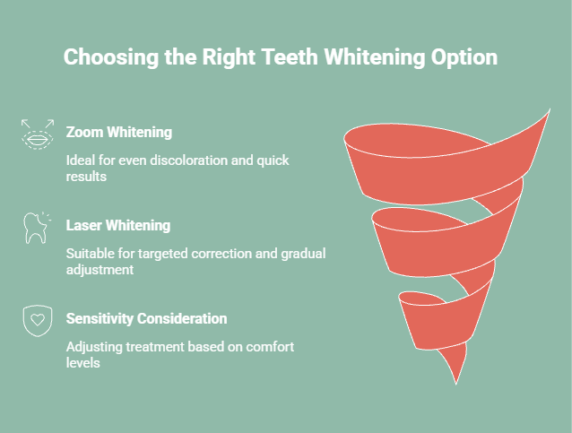
re from full-smile whitening, while others need focused correction for darker or uneven teeth.
No whitening treatment works the same way for every patient, which is why treatment planning matters.
1. Choose Zoom Whitening If
- Your discoloration is generally even across the smile
- You want noticeable whitening quickly
- You are preparing for an event or professional appearance
- You prefer full-smile brightening in one appointment
Zoom whitening is often the better fit when convenience and smile-wide consistency are the priority.
2. Choose Laser Whitening If
- One or two teeth are darker than the surrounding teeth
- You have long-standing or resistant discoloration
- You want more gradual shade adjustment
- You are concerned about uneven whitening outcomes
Laser whitening is often more suitable when whitening needs differ across individual teeth.
3. Sensitivity and Comfort Also Matter
Sensitivity can also influence which whitening method feels more comfortable. Dentists may adjust treatment intensity based on enamel thickness, gum condition, and a history of sensitivity.
- Laser whitening may help limit unnecessary whitening exposure on sensitive areas
- Zoom whitening can sometimes cause temporary sensitivity after treatment
- Sensitivity usually improves within a short period after whitening
Discussing sensitivity concerns beforehand helps dentists choose the most appropriate whitening approach.
The Best Whitening Option Depends on Your Teeth
The most effective whitening treatment depends on the type of discoloration, enamel condition, and your cosmetic goals. Stain patterns vary from person to person, which means one treatment may work better in certain situations than others.
A professional dental evaluation helps determine which whitening method is more suitable for your teeth, expected results, and long-term maintenance needs.
Why Choose Dentist Tree for Professional Teeth Whitening?
Choosing between laser and Zoom whitening is only part of the decision. The outcome also depends on how well the treatment is planned and performed. At Dentist Tree of the Heights, the focus is on selecting the right approach for your teeth, not on applying a one-size-fits-all solution.
Your care starts with a detailed evaluation of your stain type, enamel condition, and sensitivity level. From there, the treatment is adjusted to match your goals while maintaining comfort and long-term oral health.
What Makes Their Approach Different?
- Personalized treatment planning based on stain depth, tooth condition, and sensitivity
- Clear guidance on whether laser or Zoom whitening fits your needs
- Modern technology for controlled, consistent whitening results
- Comfort-focused care to reduce sensitivity during and after treatment
- Long-term approach that supports both appearance and oral health
The goal is simple: achieve noticeable whitening results that look natural and feel comfortable. If you’re unsure which whitening option is right for you, the next step is a consultation. Schedule your appointment with Dentist Tree of the Heights to get a treatment plan tailored to your smile.
Final Thought
Laser and Zoom whitening both offer professional solutions for improving tooth color, but they are designed for different needs. Zoom whitening works best for fast, full-smile brightening, while laser whitening is more suitable for controlled, targeted correction, especially for uneven or deeper stains.
Choosing the right option depends on how your teeth respond to whitening, the type of discoloration present, and the level of precision required. Taking these factors into account helps ensure that the results look balanced, natural, and aligned with your expectations over time.
Frequently Asked Questions
Is laser teeth whitening safer than Zoom whitening?
Laser and Zoom whitening are both safe when performed by a dentist. Laser may feel more comfortable due to targeted application, while Zoom is equally safe but can cause temporary sensitivity in some patients.
Are there side effects unique to Zoom or laser whitening?
Both treatments share similar side effects, mainly temporary tooth sensitivity and mild gum irritation. Laser whitening may feel gentler due to targeted application, while Zoom can cause short-term sensitivity from full-mouth exposure, including the impact of infrared emissions, but effects are usually brief and manageable.
Which is better for sensitive teeth, laser or Zoom?
Laser whitening is generally better for sensitive teeth because it allows targeted application and produces less heat. However, if done improperly, Zoom whitening may also cause nerve damage and temporary sensitivity since it treats all teeth at once.
Can laser or Zoom whitening be combined with other whitening methods?
Yes, both laser and Zoom whitening can be combined with dentist-recommended at-home kits or maintenance treatments. This helps extend results and maintain brightness, but the plan should always be guided by your dentist to avoid sensitivity or over-whitening, especially by avoiding foods and drinks like red wine that can stain your teeth.
Laser vs Zoom teeth whitening: which is better?
Laser teeth whitening vs Zoom depends on your needs. Laser is better for precision and deeper stains, while Zoom is ideal for fast, full-smile whitening with uniform results, providing the best results in one session.
How long do the results last with laser teeth whitening compared to Zoom whitening?
Laser whitening results may last slightly longer due to deeper stain removal, while Zoom whitening typically lasts 12–24 months. However, longevity depends on good oral hygiene, diet, and habits like smoking, which can affect how quickly stains return.
Can laser or Zoom whitening be combined with other whitening methods?
Yes, laser or Zoom whitening can be combined with dentist-recommended at-home trays or touch-up treatments to maintain results. However, combining methods should be done under professional guidance to avoid sensitivity, gum disease, or over-whitening.