

Key Highlights
- You can switch dentists anytime without permission.
- Your dental records belong to you. Any dental office must provide them on request.
- Switching mid-treatment is possible, though timing matters for complex procedures.
- Most dental insurance plans let you change providers at any time or at renewal.
- Choosing the right dentist involves checking credentials, reviews, services, and comfort.
- Informing your current dentist is courteous but not legally required.
- A new dentist will typically start with a full exam and review of your dental history.
- Smooth transitions depend on records transfer, insurance checks, and clear communication.
Maybe your dentist retired. Maybe you moved to a new city. Or maybe you never felt comfortable at your current dental office. Whatever the reason, switching dentists is more common than many people think, and it is easier than expected.
The confusion usually comes from not knowing what to do next. What happens to your dental records? Will your insurance still work? What if you are in the middle of a treatment plan? These are real questions, and many people do not get clear answers.
This guide covers everything step by step. By the end, you will know exactly how to change dentists, what to ask, and how to get started at a new dental practice without gaps in your care.
Can You Change Dentists Anytime?
Yes, you can. There is no rule that ties you to a dentist. You are free to switch to a new dentist whenever you choose. No approval is required from your current provider.
Many people assume they need a referral or have to wait for a specific time of year. That is not the case. You can walk into a new dental practice and book an appointment as a new patient, even if you are still listed at your old office.
The only exceptions might come from your dental insurance plan. Some plans have networks, and switching to an out-of-network dentist may affect your costs. But the choice to switch is always yours.
Signs It’s Time to Switch Dentists
If your dental visits feel stressful, inconvenient, or unsatisfying, it may be a sign that your current dental office is no longer the right fit for your needs.
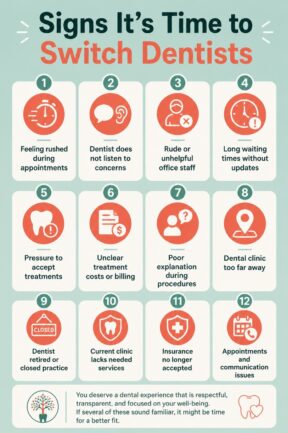
Some signs are obvious. Others are easy to ignore. But if any of these sound familiar, it may be time to find a new dental home.
- You leave appointments feeling rushed or unheard. This often leads to missed concerns, delayed diagnoses, and lower confidence in your treatment decisions. A dentist who does not listen is a risk to your oral health, not just your comfort.
- The office staff is rude, unorganised, or difficult to reach. Poor communication at the front desk usually means poor coordination behind it, including wrong billing, missed referrals, and appointments that fall through the cracks.
- Waiting times are consistently long with no explanation. Occasional delays happen. Consistent ones suggest the practice is overbooked or understaffed. Your time and your dental health both deserve better.
- You feel pressured into treatments you are unsure about. If a dentist pushes upgrades, add-ons, or procedures without a clear explanation, that is a red flag. Good dental care comes with transparent reasoning, not a sales pitch.
- Pricing and treatment costs are unclear before you agree to anything. You should never be surprised by a bill after the fact. A trustworthy dental practice explains costs, insurance coverage, and payment options upfront, every time.
- You are not told what is happening or why during treatment. Lack of transparency about your diagnosis, treatment options, or what each procedure involves makes informed decisions impossible. You have a right to understand your own oral health.
- You moved to a new area and the commute is too far. Distance is a practical barrier to consistent dental visits. If getting there feels like an effort, appointments get skipped, and small issues become bigger ones.
- Your dentist retired, closed their practice, or left your insurance network. These are straightforward reasons with no fault involved. Finding a new provider quickly protects continuity of care.
- You need a specialist or a service that your current office does not offer. If your practice cannot meet your specific needs, such as orthodontics, implants, or periodontal care, it makes sense to find one that can.
- Your dental insurance changed and your current dentist is no longer covered. Staying with an out-of-network provider can significantly increase your out-of-pocket costs. It is worth reviewing your options at renewal.
Your oral health depends on consistent, quality dental care. If your current setup is getting in the way of that for any reason on this list, switching is not just reasonable. It is the right call.
How to Switch Dentists: Step-by-Step
Switching to a new dentist takes five simple steps. When planned properly, the process is usually quick and smooth with little interruption to your dental care.
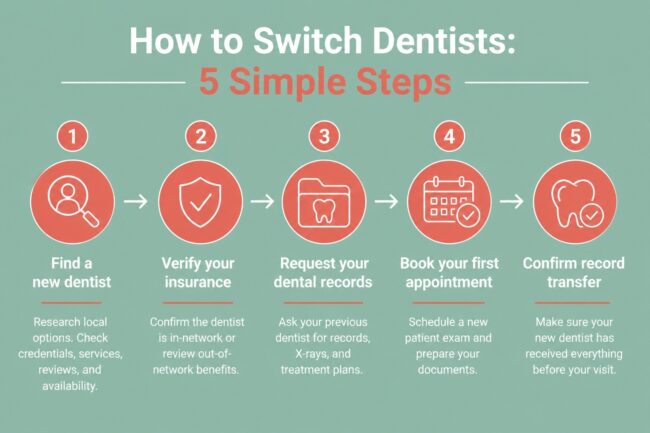
Step 1: Find a New Dentist That Fits Your Need
Start with your dental insurance provider’s website. Filter by location to get a shortlist of in-network dentists. This helps keep your costs predictable.
From there, check Google reviews. Do not just look at the star rating. Read how the office handles complaints and whether patients feel heard. A 4.3 rating with honest responses often tells you more than a perfect 5.0.
Also, check that the practice offers the dental services you need, accepts new patients, and has office hours that work for you. Once you have two or three options, call each office. How they handle that first call can tell you a lot about the patient experience.
Choosing the right dentist early can make the entire switching process easier and more comfortable.
Step 2: Verify Your Insurance Before You Book
Call your insurer and ask two things: Is this dentist in my network? Are there any waiting periods or coverage limits I should know about?
Then call the new dental office and confirm they accept your specific plan. “We take Delta Dental” does not always mean every Delta Dental plan is accepted. Verify both sides before booking.
- Waiting periods matter for major treatment. Many plans impose a 6 to 12 month wait before covering crowns or root canals. If you need significant work, ask your insurer whether a waiting period applies before committing to a new provider.
- Ask for a pre-treatment estimate. Before any non routine procedure, ask the new office to submit a pre treatment estimate to your insurer. It shows what your plan will cover before the work begins, so there are no surprises on the bill.
- Check your remaining annual maximum. Benefits already used at your previous dentist carry over. If your maximum is nearly exhausted, consider timing elective treatment to your new benefit year.
Checking your coverage before booking helps avoid delays, confusion, and unexpected costs later.
Step 3: Request Your Dental Records
Your dental records belong to you. Contact your previous dental office and ask to complete a records release form. Request your recent X-rays, clinical notes, active treatment plan, and records of previous treatments.
Some offices charge a small fee, typically between $15 and $50. Ask about this in advance. If the office is slow to respond, follow up in writing. Under HIPAA, providers must usually supply records within 30 days.
Complete records help your new dentist understand your dental history and continue your care properly.
Step 4: Book Your First Appointment
Let the new office know you are transferring from another provider. Most practices schedule a comprehensive new patient exam, usually lasting 60 to 90 minutes, to assess your oral health before recommending treatment.
This exam is not repeated without reason. Every dentist has a different baseline. Your new provider needs to assess your current oral health personally before continuing or recommending treatment. Relying only on another dentist’s notes is not considered a safe practice because conditions can change over time.
Ask whether your records should arrive before the appointment and whether there is a digital intake form you can complete in advance. This saves time during your visit.
A well-prepared first appointment helps your new provider create a clear and accurate treatment plan.
Step 5: Confirm Your Records Have Been Received
Two to three days before your appointment, contact the new office and confirm your records have arrived. Do not assume everything was transferred correctly.
If records are missing, your new dentist may need to retake X-rays on the day. That means extra time, added cost, and in some cases a separate insurance claim for imaging you have already paid for once. Some insurers will not cover duplicate X-rays taken within a certain period, leaving you to pay the difference out of pocket.
If you collected the records yourself, bring copies with you and keep a personal backup for future reference.
Taking a few minutes to confirm everything ahead of time can make your transition smoother and prevent unnecessary stress.
Do You Need to Inform Your Current Dentist?
No, you are not legally required to tell them. But it is generally a polite and practical thing to do, especially if you have ongoing treatment or outstanding appointments.
If you have upcoming appointments, cancel them in advance. This avoids no-show fees and frees up the slot for another patient. You do not need to explain your reasons. A simple cancellation call is enough.
Telling them directly also makes requesting dental records easier. When they know you are leaving, the process of retrieving your oral health history tends to go faster. You can do this by phone, email, or written letter.
Note: Your records belong to you. Even if you say nothing, your previous dentist cannot refuse a records request. HIPAA regulations in the US give you the right to access your own dental history within 30 days.
What Dental Records Should You Transfer to a New Dentist?
Your records do more than fill a file. They give your new dentist the full picture of your oral health, including past treatments, ongoing care, and issues that need monitoring. Without them, your new provider is starting without important context.
Here is what to request and why it matters:
- Recent X-rays show bone levels, root health, and hidden decay that a visual exam alone cannot detect. Without current images, your new dentist may need to retake them, adding extra cost and time.
- Clinical notes and exam findings help your new dentist understand what your previous provider observed over time. Patterns in your oral health history, such as recurring issues, healing responses, or sensitivities, are often only documented in these notes.
- Active treatment plans or incomplete procedures help ensure nothing gets missed during the transition. If a crown was planned or a cavity was left untreated, your new dentist should know before your first appointment, not after.
- Previous treatments, such as fillings, extractions, crowns, or root canals, provide important context for your current oral health. A tooth that has already had a root canal may respond differently over time, and that history can affect future treatment decisions.
- Periodontal charting tracks gum health over time. Without it, your new dentist cannot tell whether your gum condition is stable, improving, or getting worse.
- Allergy notes and medication history are a safety essential. These must transfer accurately, every time.
Some offices charge a small administrative fee for copying or transmitting records. Ask in advance so there are no surprises.
Can You Switch Dentists Mid-Treatment?
Yes, you can switch mid-treatment, but timing matters. For simple procedures like cleanings or small fillings, switching at any point is straightforward. For complex work, it is worth thinking through the timing first.
If you are midway through a crown, root canal, or orthodontic treatment, an abrupt switch can cause delays. A new dentist may want to assess everything from scratch before continuing.
What Many Patients Do Not Expect
Most new dentists will not simply pick up where another provider left off. They are not legally or professionally obligated to continue someone else’s work. Before agreeing to continue any unfinished treatment, a new dentist will typically require a full re-evaluation and rightly so. They need to assess the quality and current state of the work before taking responsibility for the outcome.
Some dentists will decline unfinished cases entirely, particularly complex ones. This is not unusual. It protects both the patient and the provider.
Prior Treatment Is Also Not Guaranteed
If a previous procedure fails, a filling that cracks or a crown that does not seat properly, your new dentist carries no liability for work they did not perform. Understanding this upfront avoids disputes later.
Here is a general guide:
- Cleanings or exams: Switch anytime, no issue.
- Fillings or extractions: Finish the current procedure if possible before switching.
- Root canals: Ideally complete at the current office to avoid complications.
- Orthodontics (braces/aligners): Transfer is possible but requires detailed records and may involve a re-evaluation fee.
- Ongoing gum treatment: Inform your new dentist immediately so treatment continues without gaps.
When in doubt, ask both offices. A good new dentist will tell you honestly whether they can continue your existing plan or whether a fresh evaluation is needed first.
What Happens to Your Insurance When You Change Dentists?
Most dental insurance plans let you change dentists at any time. But the details matter, especially if you are in a managed care plan like an HMO versus a PPO.
- PPO Plans: You can see almost any licensed dentist. Staying in-network costs less, but out-of-network care is usually still covered, just at a lower rate.
- HMO Plans: You are typically assigned a primary dentist. You may need to formally request a change through your insurer before visiting someone new.
- Employer or Group Plans: If your dental plan is employer-sponsored, changes may only be allowed during open enrollment unless you have a qualifying life event.
- Check any pending claims before you leave. If your previous dentist has submitted claims that have not yet been processed, switching mid-cycle can create coordination delays. Contact your insurer and confirm all outstanding claims are settled before your first visit to the new office.
- Pre-authorisations do not always transfer. If your previous dentist obtained pre-authorisation for a procedure you have not yet had, that approval may not be valid at a new practice. Your new dental office will likely need to submit a fresh request, which takes time and is not always guaranteed to be approved at the same rate.
- Coordination delays are common during transitions. There is often a lag between when you register at a new dental office and when your insurer updates its records. This can cause claims to be rejected on the first visit. To avoid this, confirm with both your insurer and the new office that your details are correctly registered before your appointment.
Before you book your first appointment at a new dental office, call your insurance provider. Confirm the new dentist is in their network and that your dental insurance benefits will apply from the first visit.
Disclaimer: Insurance plans vary widely. Coverage details, network availability, and switching policies differ by provider and plan type. Always confirm current details directly with your insurer.
How to Choose a New Dentist
The right dentist is someone you can trust with your oral health for the long term. Here is what to look for when making that choice.
- Credentials and experience: Check that the dentist is licensed. Look for relevant training in areas that match your specific needs, such as cosmetic dentistry, implants, or family care.
- Services offered: Look for a practice that offers comprehensive dental care. Switching offices every time you need a different service can quickly become frustrating.
- Online reviews: Check Google reviews and other trusted platforms. Pay attention to how the office handles complaints, not just positive feedback.
- Insurance acceptance: Confirm that the new dental practice accepts your insurance plan before booking your first appointment.
- Location and hours: A dentist you can easily visit and schedule with regularly is more practical than one that is difficult to reach.
- Comfort level: This matters more than many people realise. If you feel heard and respected during your first appointment, you are more likely to continue your dental visits comfortably.
If you are moving to a new city, start with your insurance provider’s website. Most insurers offer a search tool to help patients find in-network dentists by ZIP code. Online reviews can help narrow your options from there.
What Is the First Visit Like After Switching Dentists?
Your first dental visit at a new practice is mainly about getting to know each other. Expect a full exam, X-rays (unless recent ones were transferred), and a review of your dental history.
Most new patient appointments include:
- Health and medication history review
- Full mouth X-rays if not recently taken
- Gum and bone health assessment
- Cavity check and visual exam
- Discussion of any concerns or treatment needs
- Review of your previous treatment plan, if applicable
Bring your dental records, insurance card, a list of any medications, and any specific questions you have. This saves time and helps the new dentist build an accurate picture from the start.
The first appointment is also your chance to assess the office. How does the team treat you? Do they explain things clearly? This visit tells you a lot.
What Tips Can Make Switching Dentists Easier?
Planning ahead can make the entire switching process easier. A few simple steps can help you avoid delays, extra costs, and unnecessary stress during your move to a new dentist.
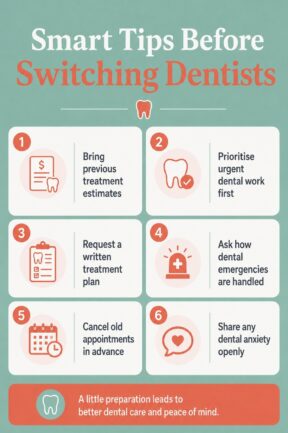
Planning ahead removes most of the friction. These tips cover what most patients only wish they had known earlier.
- Bring any previous treatment estimates. Your new dentist can confirm whether the same work is still needed and give you a fair comparison before agreeing to anything.
- Ask for treatment to be prioritised. After your first exam, ask which issues need attention first. It helps you plan financially and avoid doing everything at once.
- Request a written treatment plan. Before any procedure, ask for a written outline of what is needed, why, and the estimated cost. A trustworthy practice will provide this without hesitation.
- Ask how emergencies are handled. Find out before you need to know. Same-day availability and after-hours contact are worth confirming upfront.
- Cancel outstanding appointments at your old office. It avoids no-show fees and keeps things professional.
- Be honest about dental anxiety. A good dental office will adapt. Many practices offer comfort-focused care for nervous patients.
Making the switch does not need to be complicated. With the right preparation, most people settle into a new dental practice within one or two visits.
Switching to Dentist Tree of the Heights? We Make It Easy.
At Dentist Tree of the Heights, we work with new patients every week, many of whom are switching from another provider for the first time. We know the process can feel uncertain, and we do our part to keep it simple.
- We assist with dental records transfer directly so you do not have to manage it alone.
- We verify your insurance before your first visit to avoid surprises.
- We take time at your first appointment to review your full dental history and previous treatments.
- Our team is trained to support patients who feel nervous about switching or visiting a new office.
- We offer comprehensive dental care under one roof, from general checkups to restorative and preventive services.
If you are ready to make the switch, our team is ready to help. Book an appointment at Dentist Tree of the Heights and take the first step toward comfortable, consistent dental care.
Switching Is Simpler Than You Think
Knowing how to switch dentists means knowing four things: request your records, check your insurance, find a dental office that fits your needs, and book that first appointment.
Most people overthink the process. The truth is, dental practices handle transitions like this all the time. You are not the first, and the steps are well established.
If you have been putting off switching because it seemed complicated, now you have the full picture. Take the first step today. Your next dental visit could be the most comfortable one you have had in years.
Frequently Asked Questions
What should I say when telling my old dentist I’m switching?
Keep it brief and professional. A simple call works. Say you are moving to a new provider and request your records. No explanation is required. Most offices handle this routinely.
Will my new dentist judge me for not going to the dentist for years?
No. A good dentist focuses on your current oral health, not past gaps. Be upfront about your history and any concerns you have. They will not judge you for it.
How long does it take to transfer dental records?
Typically two to five business days, though records with multiple X-rays or lengthy history may take longer. To be safe, request them at least one week before your first appointment.
Can I switch dentists if I’m in the middle of a dental insurance year?
Yes, for most PPO plans. Your remaining benefits carry over when you switch. Call your insurer to confirm coverage and check whether any claims from your previous dentist are still pending processing.
Is it rude to switch dentists?
Not at all. Dentists understand that patients relocate, change insurance, or simply prefer a different provider. Switching is a normal part of dental care. You owe no explanation to anyone.