

Key Highlights
- Dental crowns are caps that look like a tooth. They go over teeth that are hurt or have decay. This helps to make your oral health better.
- There are different types of crowns. Some are metal, porcelain, zirconia, or resin. Each of these gives different benefits.
- A dental crown procedure often takes two trips to the dentist. At the first visit, teeth are prepared and an impression is made. At the next visit, they put the crown on the tooth.
- Dental crown cost will change based on the type of material and your treatment needs.
- Dental insurance may pay for some of the cost, mostly when crowns are needed to fix a problem.
- With the right care, your dental crown can last for many years.
You feel that pain when you bite into food and feel a sudden crack. Or you see a chipped tooth and feel too shy to smile. It’s hard, and sometimes it makes you feel scared. This is when a dental crown can help you feel better.
A crown is not just a cover for your tooth. It is like a fresh start for your smile. A crown helps bring back the strength, shape, and look of the tooth. With it, you can eat, laugh, and feel sure about yourself. It lets you enjoy your life with your friends and family without thinking all the time about your teeth.
If you want to know how dental crowns work, what kinds there are, or the price you could pay, this blog covers it all.
What Are Dental Crowns and When Do You Need Them?
So what is a dental crown? A dental crown is a strong, custom-made cap that covers and protects a damaged or weakened tooth, restoring its shape, strength, and natural appearance. It’s designed to look and feel just like your natural teeth, so it blends in perfectly with your smile.
Before placing the crown, your dentist will gently reshape the tooth by removing a thin layer of enamel. This helps the crown fit securely over the tooth and sit comfortably along the gum line, restoring both strength and appearance.
You’ll likely need a dental crown if:
- You have a cracked or chipped tooth. A small chip might not seem serious, but cracks can deepen over time. A crown acts like armor, protecting the tooth from breaking further or causing pain when chewing.
- Your tooth has a large filling or extensive decay. When most of your natural tooth structure is gone, a filling alone can’t hold up. A crown provides the support needed to keep the tooth functional and prevent it from fracturing.
- You’ve had a root canal. After root canal treatment, teeth often become brittle because the nerve is removed. Placing a crown prevents cracks, reinforces the tooth, and restores normal biting pressure.
- You’re missing one or more teeth and need a dental bridge. Crowns anchor the bridge on either side of the missing tooth space, keeping your bite aligned and preventing other teeth from shifting.
- You want to improve the look of your smile. Crowns can cover teeth that are discolored, misshapen, or uneven, creating a natural, confident smile without needing veneers or whitening.
Crowns aren’t just cosmetic; they restore comfort, strength, and peace of mind. If a tooth hurts when you bite or looks damaged, getting a crown early can stop further decay and save you from more complex procedures later.
What Are The Benefits of Getting a Dental Crown?
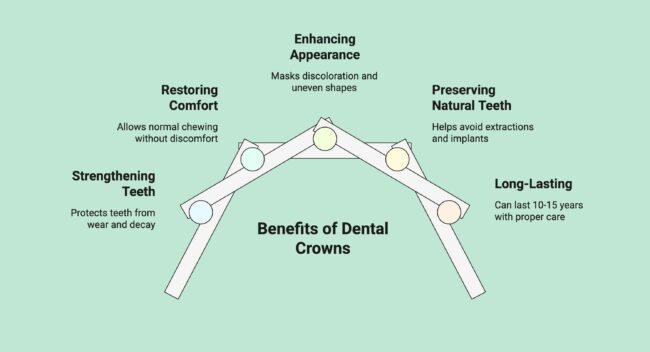
If you have a damaged or weakened tooth, a dental crown can help you strengthen your tooth and restore its natural shape. It also blends in so well that it looks just like the rest of your teeth. When properly cared for, a well-made crown can last over a decade.
Here’s why they’re worth considering:
- They strengthen and protect weak teeth. Crowns cover the entire visible surface of a tooth, shielding it from further wear, cracks, or decay. This can prevent tooth loss and future pain.
- They restore natural chewing and comfort. A well-fitted crown allows you to bite and chew normally again, without discomfort or fear of damaging your tooth.
- They improve your smile’s appearance. Crowns can mask discoloration, uneven shapes, or gaps, creating a balanced, confident smile that looks completely natural.
- They help preserve your natural tooth. By protecting the remaining tooth structure, crowns help you avoid extractions or implants down the line.
- They’re long-lasting. With daily brushing, flossing, and routine dental visits, crowns can last 10-15 years or even longer.
What Should You Expect During a Dental Crown Procedure?
Getting a dental crown is a routine process that’s both simple and comfortable compared to other dental treatments. Most treatments are completed in two visits, spaced a couple of weeks apart. Here’s what typically happens:
Preparing for Your First Appointment
Your first visit focuses on examining the tooth and preparing it for the crown. Your dentist will:
- Thorough examination and X-rays: Your dentist will carefully check your tooth and take X-rays to understand the damage and make sure the roots and surrounding bone are healthy enough to support your new crown.
- Comfort comes first: Before starting, the area will be gently numbed with local anesthesia so you stay relaxed and pain-free throughout the procedure.
- Shaping your tooth for a perfect fit: The dentist will smooth and reshape the tooth by removing a thin layer of enamel. This ensures your crown fits comfortably and looks completely natural and never bulky or uneven.
- Creating your custom crown: Impressions or digital scans of your teeth are taken to design a crown that matches the color, size, and shape of your natural teeth for a seamless smile.
- Protecting your tooth during the process: A temporary crown will be placed to cover your tooth while your permanent one is being crafted in the dental lab, so you can eat and smile comfortably in the meantime.
At this stage, your dentist will also guide you on how to care for the temporary crown until your final one is ready.
Receiving Your Permanent Crown
At your second visit, your dentist will:
- Remove the temporary crown carefully.
- Check how the permanent crown fits and feels when you bite down.
- Make small adjustments if needed for comfort and alignment.
- Cement the new crown securely into place.
With your new crown in place, your tooth is fully protected, and your smile feels as natural and strong as ever.
What Are The Different Types Of Dental Crowns?
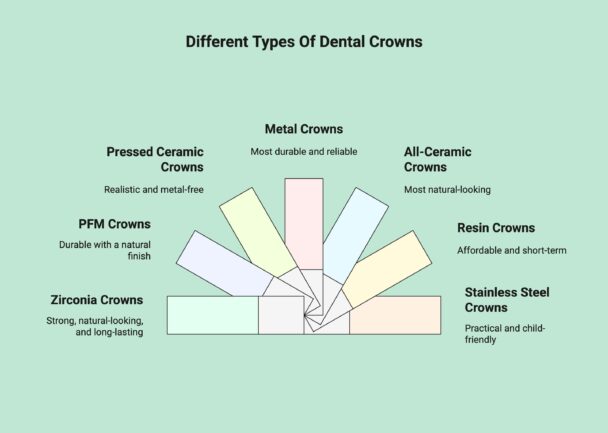
When you want to pick a dental crown, there are several different types you can use. The best type of crown for you will depend on your own needs, how much money you want to spend, and what you like. Each one is good in its own way, and each type of crown works well in certain situations.
Your dentist will guide you through these options, but understanding them beforehand can help you make a confident, informed decision. Let’s break down the most common crown materials and what makes each one a smart choice.
1. Zirconia Crowns: Strong, Natural-Looking, and Long-Lasting
Zirconia crowns are one of the most advanced and reliable options in dentistry today. Made from zirconium dioxide, a highly durable ceramic, they are both extremely strong and remarkably natural-looking, making them suitable for both front and back teeth.
Why they’re ideal: Crowns made from zirconia are known for providing a near-perfect blend of strength and aesthetics. They can handle heavy biting and grinding without cracking, which makes them a great fit for molars. At the same time, their natural translucency allows them to mimic real tooth enamel, ensuring your smile looks authentic and seamless. Unlike some metal-based crowns, zirconia is also gentle on nearby teeth and rarely causes irritation.
If your priority is a long-lasting, natural-looking restoration that doesn’t compromise durability, zirconia crowns are one of the best modern choices available.
2. Porcelain-Fused-to-Metal (PFM) Crowns: Durable with a Natural Finish
Porcelain-Fused-to-Metal (PFM) crowns combine the best of both worlds: a strong metal foundation for durability and a porcelain exterior for a natural, tooth-colored appearance. They’ve been used for decades and remain a trusted option for restoring both front and back teeth.
Why they’re ideal: PFM crowns are a great middle ground for patients who want the toughness of metal and the look of porcelain. The metal base provides reliable strength for chewing, while the porcelain coating allows the crown to blend in with your other teeth. They’re especially useful for restoring back teeth where strength matters most, but appearance is still important.
Over time, some patients may notice a faint dark line near the gums if the gums recede, as the metal edge becomes slightly visible. However, for many people, PFM crowns offer an excellent balance of performance, cost, and appearance.
3. Pressed Ceramic Crowns: Realistic and Metal-Free
Pressed ceramic crowns are made by compressing molten ceramic at high temperatures to form a hard inner core, then layering it with translucent porcelain to achieve a lifelike finish.
Why they’re ideal: Crowns made from pressed ceramic are loved for their exceptional ability to replicate natural teeth. They capture the shine and slight transparency of real enamel, making them perfect for front teeth where appearance matters most. Since they’re completely metal-free, they’re also ideal for anyone with metal sensitivities or allergies.
These crowns provide an excellent aesthetic result, especially in the visible areas of your smile. However, the thin porcelain outer layer can chip over time, so they’re better suited for teeth that don’t experience heavy biting pressure.
4. Metal Crowns: The Most Durable and Reliable Option
Metal crowns have long been valued for their unmatched strength and longevity. They are typically made from gold alloys or other metals like palladium, nickel, or chromium.
Why they’re ideal: Metal crowns are known for being virtually unbreakable, making them the top choice for restoring molars or teeth that do most of the chewing. They rarely chip or wear down and are gentle on opposing teeth. Because less enamel needs to be removed, they help preserve more of your natural tooth structure.
While their metallic color makes them less suitable for visible teeth, they are the most durable and low-maintenance option for people who value function and reliability above aesthetics. Many patients choose gold or metal crowns for back teeth that aren’t easily seen but need lasting strength.
5. All-Ceramic or All-Porcelain Crowns: The Most Natural-Looking Option
If you’re looking for a crown that blends seamlessly with your other teeth, all-ceramic or porcelain crowns are your best choice. These crowns contain no metal and reflect light in the same way natural enamel does, creating a flawless appearance.
Why they’re ideal: Crowns made from all-ceramic and porcelain dental crowns are known to provide the best color match to your natural teeth. They have a translucent quality that mimics real enamel, giving your smile a smooth, natural glow. Because they contain no metal, they’re perfect for patients with allergies or those who prefer a metal-free restoration.
Modern materials like E-Max (lithium disilicate) have also made these crowns much stronger, allowing them to be used even on back teeth in many cases. If your main goal is to achieve a bright, natural, and metal-free smile, these crowns offer the best aesthetic results.
6. Resin Crowns: Affordable and Short-Term Solution
Resin crowns are made from composite resin, the same tooth-colored material used for fillings. They’re less expensive than other types of crowns, making them a cost-effective choice for temporary or short-term restoration.
Why they’re ideal: Crowns made from resin are great for those who need a budget-friendly or temporary fix. They blend nicely with your natural teeth, are gentle on opposing teeth, and rarely cause sensitivity. However, they aren’t as durable as other materials and can wear down or break more easily over time.
Resin crowns generally last about 3 to 5 years and are best suited for situations where a longer-term crown will be placed later or when cost is the main concern.
7. Stainless Steel Crowns: Practical and Child-Friendly
Stainless steel crowns are commonly used for children’s primary (baby) teeth. They provide full coverage and protection until the baby tooth naturally falls out, preventing further decay or damage.
Why they’re ideal: These crowns are quick, affordable, and reliable, making them perfect for pediatric dentistry. They’re placed in a single visit and help maintain space for the permanent tooth while protecting the baby tooth from decay. For kids who struggle with multiple cavities, stainless steel crowns can save time, discomfort, and future dental complications.
Though they’re not used for adult teeth, stainless steel crowns are one of the most effective ways to maintain oral health in children until their permanent teeth grow in.
How Much Do Different Dental Crown Materials Cost?
Choosing the right dental crown material can make a big difference in durability, comfort, and how natural your smile looks. Each material offers unique benefits, from long-lasting metal crowns to highly aesthetic ceramic options. Here’s a quick breakdown of what to expect:
- Zirconia: Best for patients who want both strength and a natural look. Lasts 10 to 15+ years with excellent color match that mimics real enamel. The average cost $1,000 to $2,000.
- Porcelain-Fused-to-Metal (PFM): Ideal for front and back teeth needing a balance of durability and appearance. Lasts around 10 to 15 years with good color blending, though a thin metal line may appear near the gum line over time. The average cost $800 to $1,800.
- Pressed Ceramic: Great choice for front teeth that require a natural, lifelike look. Typically lasts 8 to 12 years with a realistic enamel-like shine. The average cost $1,000 to $1,800.
- All-Ceramic / Porcelain (E-Max, Lithium Disilicate): Perfect for those seeking the most natural, metal-free option. Lasts 10 to 15 years and provides outstanding brightness and color accuracy. The average cost $1,000 to $2,000.
- Metal (Gold, Palladium, Nickel-Chromium): Best suited for back molars that need maximum strength. It can last 15 to 25+ years, but the metallic color makes it less ideal for visible teeth. The average cost $800 to $2,500.
- Resin (Composite): A budget-friendly or temporary solution. Lasts about 3 to 5 years and offers fair aesthetics, though it may discolor over time. The average cost $300 to $800.
- Stainless Steel: Commonly used for children’s baby teeth to provide full coverage until they naturally fall out. Silver metallic finish. The average cost $150 to $400.
Disclaimer: The prices listed above are general estimates based on typical U.S. dental costs. Actual pricing may vary depending on your dentist, location, tooth condition, and treatment complexity. Always consult your dental provider for an accurate quote.
How to Choose the Right Dental Crown Material for You?
Every patient’s needs are different, and there’s no one-size-fits-all crown. Your dentist will help you decide based on the location of the tooth, how much chewing force it handles, your cosmetic goals, any metal allergies, and your budget.
Here’s how to think about it:
- If you want maximum strength, go with metal or zirconia.
- If you want a natural, lifelike smile, choose all-ceramic or porcelain.
- If you need a temporary or affordable fix, resin may be your best bet.
- For children, stainless steel is the most practical choice.
In the end, the right crown is the one that fits your lifestyle, protects your oral health, and gives you the confidence to smile without hesitation.
How to Care for a Dental Crown and Make It Last?
Getting a dental crown is a big step toward protecting your teeth, but keeping it in great shape depends on how you care for it every day. The crown itself can’t decay, but the tooth underneath (especially near the gum line) still needs attention.
Here’s how you can make your crown last for years:
- Brush twice a day: Use a soft-bristled toothbrush and fluoride toothpaste to clean around your crown gently but thoroughly.
- Floss daily: Slide the floss carefully around your crown to remove plaque and food particles that brushing might miss.
- Rinse with mouthwash: An antibacterial mouthwash helps reduce bacteria and keeps your gums healthy.
- Avoid hard foods: Try not to chew on ice, hard candies, or pens, as they can crack or loosen your crown.
- Visit your dentist regularly: Schedule routine checkups and cleanings. Your dentist will check the crown’s fit and make sure your gums and surrounding teeth stay healthy.
- Watch for changes: If your crown ever feels loose, sensitive, or uncomfortable, don’t wait, book an appointment right away.
Taking these small daily steps will keep your crown strong, your smile healthy, and your confidence high for years to come.
Dentist Tree of the Heights: Need a Trusted Expert for Your Dental Crown?
When cavities, cracks, or broken teeth leave you feeling self-conscious, Dentist Tree of the Heights is here to help you regain your confident smile. Our experienced team has spent decades perfecting the art of dental crowns and bridges, combining precision, comfort, and care to restore your tooth beautifully.
We believe every smile deserves detailed, lasting care. From gentle procedures to natural-looking results, we make your experience smooth and stress-free.
Ready to restore your tooth? Call our Houston office today and let our caring team bring your smile back to its best.
Conclusion
Dental crowns help with many dental problems and are important for your oral health. You can find crowns that last a long time, like zirconia, or ones that look nice, like porcelain. Picking the right crown matters for how your teeth work and how they look. Taking care of your crowns the right way will make them last longer. This keeps your teeth in good shape over the years.
Frequently Asked Questions
Does dental insurance cover crown procedures?
Most dental insurance plans cover part of the cost for crowns when needed for health reasons, like repairing damage or after a root canal. Cosmetic crowns are usually not covered.
What should I know about dental crown and pain after the procedure?
Dental crown and pain often go hand in hand briefly after placement. Mild soreness is normal, but sharp or lasting pain could indicate infection, bite issues, or nerve irritation.
What are the disadvantages of dental crowns, and how do dental crowns before and after compare?
The disadvantages of dental crowns include possible sensitivity, dental crown cost, and replacement over time. Still, dental crowns before and after photos show major improvements in strength, appearance, and overall dental health.
What is dental glue for crowns and when should it be used?
Dental glue for crowns is a temporary fix if your crown falls off. It helps hold the crown until your dentist reattaches it professionally. Avoid chewing hard foods.
What does dental cement for crown do?
Dental cement for a crown acts as a strong adhesive that permanently bonds the crown to your tooth. It seals gaps, prevents bacteria, and ensures long-lasting stability and comfort.
What should I expect after getting a dental crown placed?
After getting a dental crown, you might feel mild sensitivity or soreness for a few days. Avoid hard foods initially and maintain good oral hygiene. Any discomfort usually fades as your mouth adjusts.
How long does a temporary dental crown last?
A temporary dental crown usually lasts one to three weeks. It protects the prepared tooth until your permanent crown is ready. Avoid sticky or hard foods to prevent loosening.
Is dental crown soreness normal after the procedure?
Yes, dental crown soreness is common for a few days after placement. It’s usually due to gum irritation or bite adjustment and improves with over-the-counter pain relief or saltwater rinses.
Are inexpensive dental crowns a good option?
Inexpensive dental crowns can restore teeth effectively, but may use less durable materials. Discuss options with your dentist to balance cost, appearance, and long-term strength before deciding.