

Key Highlights
- Invisalign treatment offers a nearly invisible appearance with its clear aligners, while traditional braces use visible metal brackets.
- The cost of braces can sometimes be lower than Invisalign, but prices often overlap.
- Your oral hygiene routine is simpler with Invisalign because the aligners are removable.
- Treatment time varies; Invisalign is often faster for milder cases.
- Patient compliance is crucial for Invisalign, as aligners must be worn 20-22 hours daily.
Trying to decide between braces and Invisalign? It can be tough to know which option will give you the best results, especially when you’re balancing comfort, cost, and convenience. Which one is truly right for you?
Your goal is a confident smile and a treatment that fits your lifestyle, comfort level, and timeline without regrets later.
This guide breaks down the key differences between braces and Invisalign, including effectiveness, cost, appearance, and who each option is best suited for, so you can choose wisely and confidently.
What Should You Know Before Choosing Braces or Invisalign to Fix Crooked Teeth or Bite Issues?
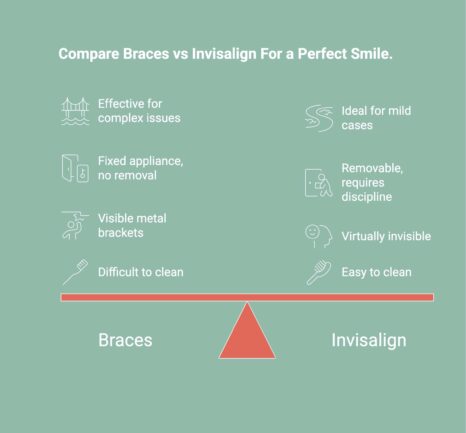
When considering orthodontic treatment, the two most popular choices are traditional braces and Invisalign. Each method is designed to improve your oral health and straighten your teeth, but they use distinct technologies and approaches. Understanding the fundamentals is the first step in deciding which path is right for you.
Traditional braces use metal brackets and wires, a time-tested method for correcting alignment. In contrast, the Invisalign treatment utilizes a series of custom-made clear aligners to gradually shift your teeth. Let’s explore these options in more detail.
What Are Braces and Who Are They Best Suited For?
Traditional braces are a highly effective orthodontic treatment option for straightening teeth that has been trusted for decades. They consist of metal brackets that are attached to each tooth and connected by a thin metal wire. This system applies continuous, gentle pressure to guide your teeth into their correct positions over time.
This method is known for its effectiveness in treating a wide variety of orthodontic issues, from simple crowding to more complex bite problems. One of the main differences between braces and Invisalign is that braces are a fixed appliance. You cannot remove them yourself, which means they are working 24/7 to straighten your smile.
They are particularly suited for:
1. Moderate to Severe Crowding or Spacing
Braces are ideal for patients with moderate to severe crowding or spacing issues, as they can effectively move teeth into proper alignment.
2. Complex Bite Problems
Braces are a strong choice for individuals with complex bite problems, such as overbite, underbite, crossbite, or open bite.
3. Significant Rotation or Vertical Movement
Braces work well for cases where teeth require significant rotation or vertical movement that aligners may not address as effectively.
4. Younger Patients or Those Needing More Structure
Braces are beneficial for younger patients or individuals who may struggle with the discipline of wearing removable aligners consistently.
5. Predictable, Hands-Off Treatment
Braces are a reliable option for those who want predictable results without needing to manage removable Invisalign trays, as they are fixed in place.
If you fall into any of these categories, braces might be the right choice for achieving a beautifully straight and functional smile.
If you’re curious about the key principles of effective oral hygiene, don’t miss our detailed guide on Oral Hygiene.
What Is Invisalign and Who Is It Best Suited For?
Invisalign is a modern approach to straightening teeth that uses a series of custom-made clear aligners. These removable aligners are made from a smooth, comfortable plastic that is virtually invisible when worn. This makes it a popular choice for adults and teens who want a more discreet treatment option for a straighter smile.
Unlike braces, Invisalign aligners are removable. You can take them out to eat, drink, brush, and floss, which makes maintaining oral hygiene much simpler. However, this flexibility requires discipline, as the aligners must be worn for 20-22 hours a day for the treatment to be effective.
Who Invisalign is best suited for;
1. Mild to Moderate Alignment or Spacing Concerns
Invisalign is ideal for patients with mild to moderate alignment or spacing issues, offering a more comfortable alternative to traditional braces.
2. Adults and Teens Looking for a Discreet Option
It’s a great choice for adults and teens who want a nearly invisible treatment that doesn’t affect their appearance.
3. Individuals Who Prefer Flexibility
Invisalign is suitable for people who prefer to remove their aligners for eating, brushing, and special occasions, offering more convenience than fixed braces.
4. Those Who Value Comfort and Fewer Food Restrictions
Invisalign works well for patients who value comfort and convenience, as the aligners don’t have the same food restrictions as braces.
5. Disciplined Wearers Committed to Consistent Progress
It’s best for disciplined wearers who can commit to wearing their aligners for 20 to 22 hours each day to ensure consistent progress and results.
If you fit these criteria, Invisalign may be the perfect fit for your lifestyle and treatment goals.
What Are The Main Differences Between Invisalign and Traditional Braces?
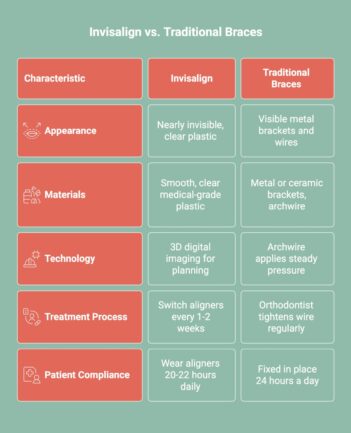
When you compare Invisalign and traditional braces, you’ll find several key differences that can help make an informed decision. The most noticeable distinction is their appearance, with clear aligners offering a nearly invisible look compared to visible metal brackets. However, the differences go beyond aesthetics.
1. Appearance
Braces: Traditional braces use visible metal brackets and wires that are attached to your teeth. They can be pretty noticeable when you smile, talk, or eat. Some people don’t mind the look, while others prefer something more discreet.
Invisalign: Invisalign aligners are made from clear, smooth plastic and are nearly invisible when you wear them. They fit over your teeth like a thin mouthguard, making them a great option if you want something less noticeable.
2. Materials
Braces: The brackets in traditional braces are usually metal or ceramic, and they’re connected by a wire. Sometimes, colored elastic bands are added, which can make them a fun, personalized choice.
Invisalign: Invisalign aligners are made from a clear, medical-grade plastic that’s smooth and comfortable to wear. There are no wires or brackets, so they feel less bulky compared to traditional braces.
3. Technology
Braces: Traditional braces rely on metal or ceramic brackets, which are held together by a wire that’s adjusted regularly by your orthodontist. The pressure applied by the wire gradually shifts your teeth into place.
Invisalign: Invisalign uses advanced 3D imaging technology to create a custom treatment plan for your teeth. You’ll wear a series of clear aligners that are replaced every 1-2 weeks, with each new set gently moving your teeth closer to alignment.
4. Treatment Process
Braces: Once braces are put on, they stay in place until your treatment is complete. You’ll visit your orthodontist periodically for adjustments to the wire, which keeps your teeth moving in the right direction.
Invisalign: Invisalign aligners are removable, so you can take them out when eating or brushing your teeth. You need to wear them for 20-22 hours a day for the best results. You’ll get a new set of aligners every one to two weeks as your teeth gradually shift.
5. Patient Compliance
Braces: Once you have traditional braces, the treatment pretty much runs itself. Your orthodontist makes the adjustments, and you don’t need to worry about taking care of them on a daily basis.
Invisalign: With Invisalign, patient compliance is key. You’ll need to make sure you’re wearing the aligners for the recommended hours each day to keep your treatment on track. It’s up to you to stick to the schedule for the best results.
What Are the Pros and Cons of Choosing Invisalign Versus Braces?
Choosing between Invisalign and braces involves understanding the advantages and limitations of each option. While both can effectively straighten teeth, they impact your lifestyle and treatment experience differently.
For many patients, appearance and comfort are major deciding factors, while others prioritize reliability and effectiveness for complex cases.
Knowing the pros and cons helps you decide which approach fits your daily routine and long-term goals.
Advantages and Drawbacks of Invisalign
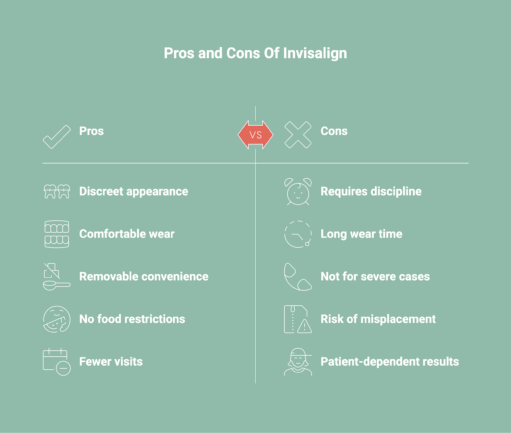
Invisalign or clear aligners offer a highly discreet solution that blends naturally with your smile, which makes them especially appealing for adults and teens who prefer a subtle treatment approach. The removable design also provides convenience for eating and brushing, and many users find the smooth plastic more comfortable than brackets and wires.
These are a few advantages of Invisalign
- Invisalign aligners are nearly invisible when worn, which allows you to straighten your teeth discreetly.
- The smooth plastic aligners are generally more comfortable and less likely to cause irritation to the cheeks or gums.
- The aligners are removable, which makes brushing, flossing, and eating much easier.
- There are no food restrictions because you remove the aligners before meals and snacks.
- Invisalign typically requires fewer in-office visits, with checkups usually scheduled every six to eight weeks.
Here are the drawbacks of Invisalign
- Invisalign requires strict discipline because forgetting to wear the aligners can delay progress.
- The aligners must be worn 20 to 22 hours per day, which may be challenging for some patients.
- Invisalign may not be suitable for severe alignment problems, complex bite issues, or major tooth rotations.
- Removable aligners can be misplaced or damaged if not handled carefully.
- Results depend heavily on consistent patient participation throughout the treatment process.
Benefits and Limitations of Braces
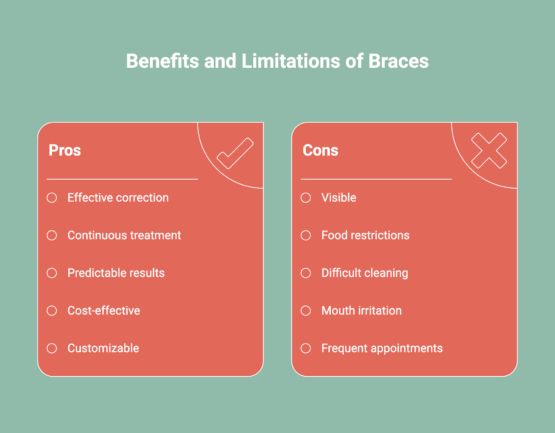 Braces remain a trusted orthodontic option thanks to their ability to treat a wide range of dental issues, including severe crowding and complex bite problems. Because they are fixed to the teeth, the treatment progresses continuously without relying on patient discipline.
Here are the benefits of braces
- Braces are highly effective for correcting complex or severe alignment and bite issues.
- They do not require patient compliance, since they stay fixed to the teeth and work continuously.
- Braces offer predictable and reliable results, supported by decades of proven success.
- They can be more cost-effective than Invisalign for some patients.
- Customizable colored bands allow patients, especially younger ones, to personalize their look.
The following are the limitations of braces
- Braces are visibly noticeable because they use brackets, wires, and sometimes elastics.
- Food restrictions are necessary to prevent damaging the brackets and wires.
- Brushing and flossing require additional time and strategies to clean around the hardware.
- Wires or brackets may cause irritation to the inside of the mouth, especially at the beginning.
- More frequent adjustment appointments are typically required to keep treatment progress on schedule.
How Much Do Invisalign vs Braces Cost in Houston, and What Should You Expect Financially?
Cost is an important part of choosing between teeth straightening options, especially when you want results that fit your budget and lifestyle. Many people researching treatment costs find themselves wondering, is Invisalign cheaper than braces and how much of a difference the cost actually makes when deciding.
Many orthodontic offices in Houston offer financing or monthly payment plans, and dental insurance plans may cover part of the cost. Taking the time to review payment options can make treatment feel much more manageable.
Let’s have a look at the Invisalign vs braces cost comparison in detail.
Invisalign Cost in Houston and What Affects the Price?
Invisalign is designed using digital planning and custom-manufactured aligner trays, which influences the overall cost. Many patients choose Invisalign for the flexibility and discreet appearance, and they often want to understand how pricing compares to braces.
Typical Invisalign cost in Houston
- Invisalign treatment in Houston generally ranges between US $3,500 and US $8,000.
- The price can increase for complex cases that require more aligners and a longer treatment time.
Factors affecting the price of Invisalign
- More complicated alignment or bite issues usually require more aligners and increase the total price.
- The number of aligner trays needed is determined by the level of movement your teeth require.
- Digital 3D treatment planning technology contributes to the overall cost of Invisalign.
- Aligners need to be replaced regularly during treatment, which influences pricing.
- Dental insurance may cover a portion of the cost, which helps reduce out-of-pocket expenses.
- Many Houston orthodontists offer flexible payment plans to make monthly budgeting easier.
Cost of Braces in Houston and What Affects the Price?
Traditional braces are often slightly more affordable than Invisalign, although the cost can overlap depending on the type of braces and treatment complexity. Some people prefer braces for their ability to correct more severe issues without relying on patient discipline.
Cost of braces in Houston
- Metal braces in Houston typically range between US $3,000 and US $7,000.
- Ceramic braces that blend in with teeth usually cost between US $4,000 and US $8,500 since the materials are more expensive.
Factors affecting the price of braces;
- Severe alignment and bite problems may require longer treatment, which increases the total cost.
- The type of braces you choose affects pricing, including metal, ceramic, or lingual options.
- Frequent adjustment visits are part of braces treatment and contribute to the cost structure.
- Dental insurance may cover a portion of orthodontic treatment, which helps reduce financial pressure.
- Most orthodontists offer payment plans, which can make braces more affordable month to month.
Choosing the right option becomes easier once you understand what affects the price of both treatments, and a detailed Invisalign vs braces cost comparison can help you decide which approach feels like the best value for your smile.
Are You Searching for a Trusted Orthodontic Solution at Dentist Tree of the Heights?
Feeling self-conscious about crooked teeth, bite problems, or gaps can affect your confidence every time you talk, laugh, or smile in photos. Many people struggle silently, wishing for a solution that is effective, comfortable, and fits their lifestyle without disruption. You should never feel limited by your smile.
At Dentist Tree of the Heights, you receive full-service orthodontic options designed to deliver real, lasting change. Whether you need braces to correct complex bite concerns or want the discreet flexibility of Invisalign, our team provides personalized care and guidance to help you achieve the smile you have always wanted.
Ready to begin your transformation? Schedule your appointment at Dentist Tree of the Heights today.
Conclusion
Choosing between Invisalign and traditional braces ultimately comes down to your personal needs and preferences. Both options have their unique advantages and disadvantages, from appearance to comfort and cost.
It’s crucial to weigh these factors carefully and consult with your orthodontist to determine the best fit for your smile goals.
Remember, a beautiful smile is an investment in yourself, and the right choice will help you achieve that while ensuring your journey is as pleasant as possible.
Frequently Asked Questions
Is Invisalign or braces more effective for straightening teeth?
The effectiveness of Invisalign or braces depends on your individual orthodontic needs. Traditional braces are more effective for complex crowding or bite corrections, while Invisalign can be equally successful for mild to moderate alignment and provides a more discreet appearance.
How do the treatment times compare between Invisalign and braces?
Treatment time varies from case to case. Invisalign treatment usually takes about twelve to eighteen months. Braces often require 18 to 24 months, especially for more complex orthodontic concerns. Your orthodontist will estimate a personalized timeline based on your needs.
Are braces cheaper than Invisalign?
Braces are often slightly cheaper than Invisalign, especially traditional metal braces, because they require fewer custom materials. However, costs can overlap depending on the case. Many orthodontists offer payment plans, and insurance coverage may reduce expenses for either treatment choice.
Which is more affordable, Invisalign or braces?
Braces are considered more affordable than Invisalign aligners, although both can fall within a similar price range depending on complexity. Payment plans are commonly available, and dental insurance often covers part of the cost, reducing financial responsibility for patients.
Can I switch from braces to Invisalign during treatment?
It is sometimes possible to switch from braces to Invisalign during treatment, depending on your tooth movement progress and orthodontic requirements. Your orthodontist can evaluate whether switching is appropriate and determine the ideal timing to achieve successful results.
Are there any age restrictions for Invisalign compared to braces?
There are no strict age restrictions for Invisalign or braces. Both treatments are suitable for teens and adults. Invisalign requires consistent daily wear, so it is recommended for responsible patients who can commit to wearing aligners as directed throughout treatment.
Is Invisalign more effective than braces?
Invisalign is effective for mild to moderate alignment issues, although braces may be more effective for complex bite concerns or severe crowding. Effectiveness depends on individual needs, treatment goals, and your ability to follow instructions consistently throughout the entire process.
Is Invisalign faster than braces?
Invisalign may be faster for mild alignment corrections because treatment is digitally planned and aligners change frequently. Braces can sometimes be faster for severe or complicated cases. Treatment speed always depends on tooth movement response, commitment, and overall orthodontic complexity.